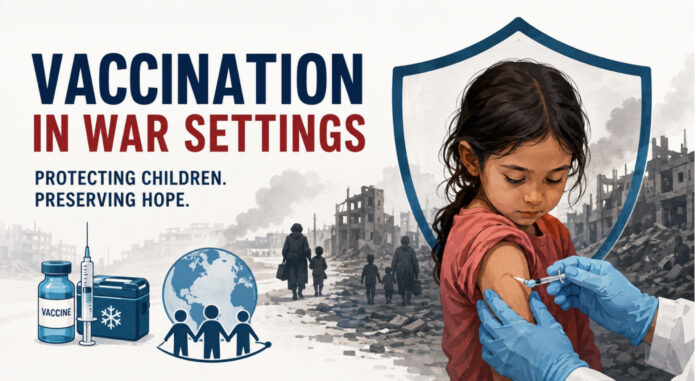
War destroys far more than buildings. It fractures health systems, displaces families, interrupts electricity and refrigeration, separates children from vaccination records, drives health workers away, and transforms a missed vaccine appointment into months—or years—without protection.
Vaccination is sometimes regarded as a routine health service that can be postponed until security returns. History repeatedly shows the danger of that assumption. Measles, polio, diphtheria, pertussis, meningitis, and other vaccine-preventable diseases do not wait for ceasefires. They exploit overcrowded shelters, malnutrition, unsafe water, interrupted primary care, declining surveillance, and weakened population immunity.
Children living in fragile, conflict-affected, or humanitarian settings represent a disproportionate share of those left unvaccinated. Although approximately one-quarter of the world’s infants live in 26 countries affected by fragility, conflict, or humanitarian crises, these countries account for around half of all unvaccinated children. The number of unvaccinated children in half of these countries increased from approximately 3.6 million in 2019 to 5.4 million in 2024.
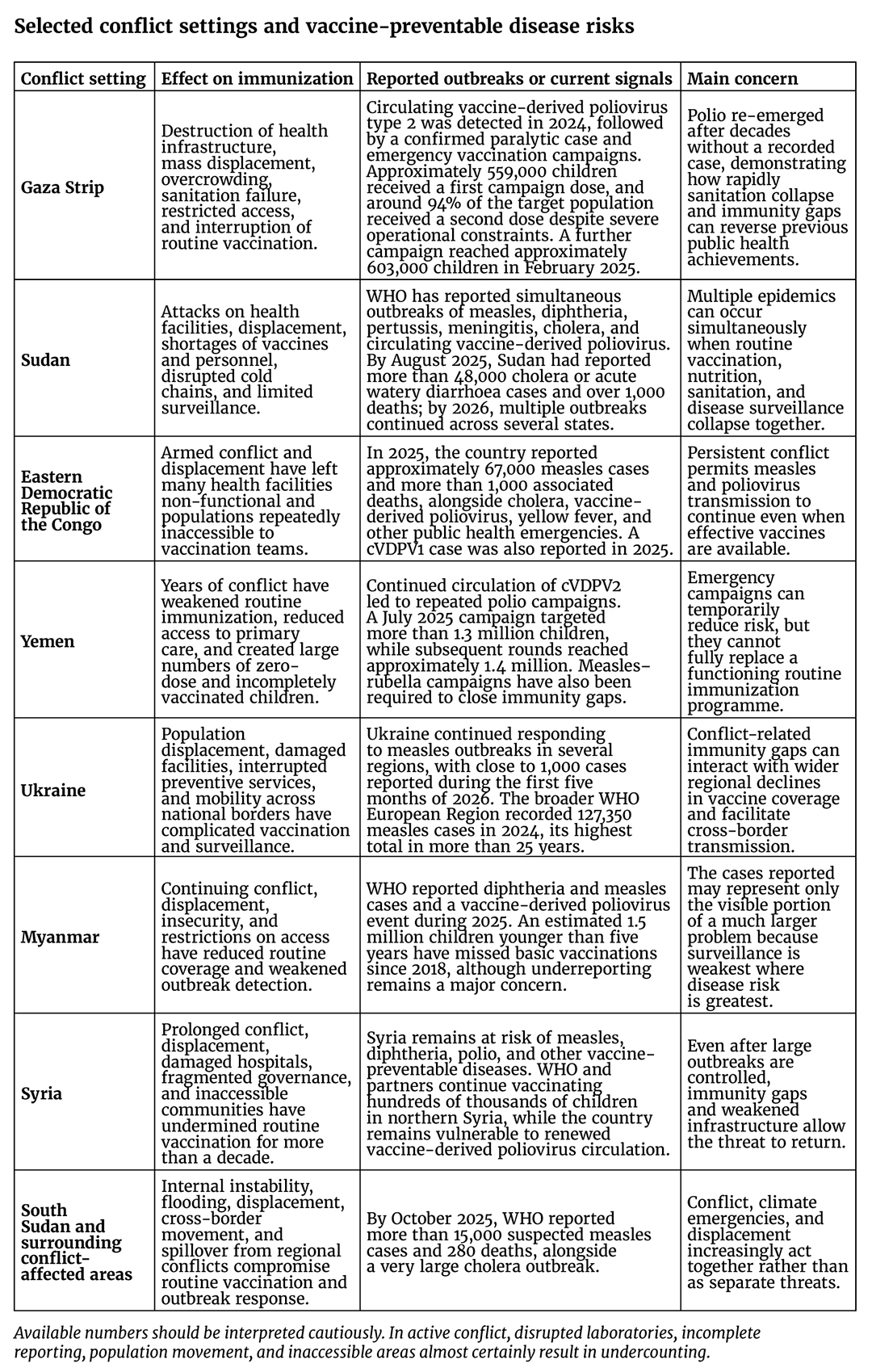
The consequences are visible across several of today’s major conflict settings.
Why war creates the ideal environment for outbreaks
The relationship between conflict and vaccine-preventable disease is not accidental. It follows a predictable chain:
Health facilities are damaged or closed. Routine vaccination becomes irregular, while antenatal care, birth-dose vaccination, and follow-up appointments decline.
Cold chains fail. Electricity shortages, fuel insecurity, damaged refrigerators, and blocked supply routes threaten vaccine potency and availability.
Families are displaced. Children lose vaccination cards, move repeatedly, and may be excluded from both their original health system and the one serving their temporary location.
Crowding accelerates transmission. Shelters, camps, hospitals, and informal settlements facilitate the spread of measles, pertussis, diphtheria, meningococcal disease, influenza, COVID-19, and other respiratory infections.
Malnutrition increases severity. A malnourished child is not only more susceptible to infection but also more likely to experience complications and death.
Sanitation deteriorates. Damage to water and sewage infrastructure creates conditions for poliovirus, cholera, hepatitis A, and other enteric pathogens to spread.
Surveillance becomes blind. When laboratories close and health workers cannot safely reach communities, the apparent absence of disease may simply reflect the absence of detection.
This last point deserves emphasis: in war, lack of reported cases is rarely reassuring. It may be evidence that the surveillance system itself has become a casualty.
Vaccination during conflict is possible
The experience in Gaza demonstrated that even under extreme conditions, temporary humanitarian pauses, careful microplanning, community engagement, and coordination among international agencies and local health workers can reach hundreds of thousands of children.
Syria’s response to a vaccine-derived poliovirus outbreak likewise showed that negotiations with multiple parties and mass vaccination campaigns could reach millions of children, including those living in areas of active conflict.
These achievements are remarkable, but they should not be romanticized. Heroic emergency campaigns are expensive, dangerous, and less sustainable than uninterrupted routine immunization. Health workers should not have to risk their lives to provide an intervention that could have been delivered safely through functioning primary care.
The principal challenges
Humanitarian access must be treated as a health intervention
Vaccines cannot protect children if borders are closed, convoys are delayed, or vaccinators cannot safely enter communities. Negotiated humanitarian access and vaccination pauses should be regarded as essential components of outbreak control—not as political concessions.
Health workers and facilities require protection
Attacks on healthcare do more than cause immediate casualties. They remove vaccinators, laboratories, maternity services, refrigerators, records, and public trust. Their effects persist long after the attack itself.
Routine immunization must continue alongside campaigns
Emergency campaigns are essential during outbreaks, but repeatedly vaccinating against one pathogen while routine services collapse leaves children exposed to many others. Polio response should be integrated, where feasible, with measles, diphtheria, tetanus, pertussis, pneumococcal, rotavirus, and other age-appropriate vaccination.
Vaccination records must follow displaced people
Interoperable digital records, portable paper cards, simplified catch-up schedules, and policies that permit vaccination without complete documentation are crucial. In uncertainty, the risk of giving an additional vaccine dose is generally far smaller than the risk of leaving a child unprotected.
Surveillance must be adapted to conflict
Community-based reporting, environmental poliovirus surveillance, rapid diagnostic testing, mobile laboratories, and cross-border data sharing can partially compensate for damaged conventional systems.
Local communities must lead
International organizations provide financing, vaccines, logistics, and technical expertise, but local health workers, religious leaders, civil society organizations, and community representatives determine whether families trust and accept vaccination. Community participation should begin during planning, not after a campaign has already been designed.
Financing must be predictable, not reactive
Vaccination programmes cannot depend entirely on emergency appeals issued after an outbreak begins. Stockpiles, transport capacity, cold-chain equipment, security planning, and trained personnel must be funded before crises escalate.
A responsibility shared by all nations
Vaccination during war cannot be considered solely the responsibility of the affected country. Many governments experiencing conflict no longer control all their territory, health infrastructure, borders, or financial systems. Expecting them to preserve universal immunization without external assistance is unrealistic and inequitable.
A truly global response requires:
- Governments and parties to conflict to guarantee safe, sustained humanitarian access;
- WHO and UNICEF to coordinate technical guidance, surveillance, procurement, and emergency campaigns;
- Gavi and other financing institutions to provide flexible funding for routine and catch-up vaccination;
- Vaccine manufacturers to maintain emergency reserves, transparent allocation, and affordable pricing;
- Neighbouring countries to vaccinate refugees and displaced populations without administrative barriers;
- Donors to finance preparedness and routine services—not only highly visible outbreak responses;
- Academic institutions to generate practical evidence on vaccination schedules, cold-chain alternatives, and delivery strategies in unstable environments;
- Civil society and local leaders to participate equitably in decision-making;
- The international community to protect health workers and hold accountable those who attack healthcare.
Equity does not mean delivering the same intervention everywhere. It means providing more resources, flexibility, and protection where the obstacles are greatest.
Conclusion
War does not eliminate the need for vaccination; it intensifies it.
A child displaced by conflict has the same right to protection as a child living in peace. Borders, political status, ethnicity, religion, and the actions of governments or armed groups should never determine whether that child receives a measles, polio, diphtheria, pneumococcal, or other life-saving vaccine.
Vaccination in war settings is not simply a technical challenge. It is a test of global solidarity.
When the world fails to maintain immunization during conflict, outbreaks are not unexpected accidents. They are the foreseeable consequences of decisions: delayed access, insufficient funding, attacks on healthcare, fragmented coordination, and unequal concern for human life.
Vaccines cannot stop wars. But even in war, they can prevent suffering, disability, and death.
Protecting that possibility is a responsibility shared by every government, organization, manufacturer, donor, health professional, and community.
Bibliography:
- World Health Organization, UNICEF. Global childhood vaccination coverage holds steady, yet over 14 million infants remain unvaccinated. 2025. https://www.who.int/news/item/15-07-2025-global-childhood-vaccination-coverage-holds-steady-yet-over-14-million-infants-remain-unvaccinated-who-unicef.
- World Health Organization. Global health leaders urge action on immunization priorities at the Seventy-eighth World Health Assembly. 2025. https://www.who.int/news/item/04-06-2025-global-health-leaders-urge-action-on-immunization-priorities-at-seventy-eighth-world-health-assembly.
- WHO, UNICEF. Polio campaign in Gaza Strip reaches around 603,000 children with better access. 2025. https://www.unicef.org/mena/press-releases/humanitarian-access-improves-quality-polio-vaccination-campaign-gaza-strip.
- World Health Organization. Sudan: 1,000 days of war deepen the world’s worst health and humanitarian crisis. 2026. https://www.who.int/news/item/09-01-2026-sudan-1000-days-of-war-deepen-the-world-s-worst-health-and-humanitarian-crisis.
- World Health Organization. Cholera—multi-country, with a focus on countries experiencing current surges. 2025. https://www.who.int/emergencies/disease-outbreak-news/item/2025-DON579.
- World Health Organization. Democratic Republic of the Congo: Health Emergency Appeal 2026. https://www.who.int/publications/m/item/democratic-republic-of-the-congo–who-health-emergency-appeal-2026.
- World Health Organization. Statement of the Forty-fourth Meeting of the Polio IHR Emergency Committee. 2026. https://www.who.int/news/item/04-03-2026-statement-of-the-forty-fourth-meeting-of-the-polio-ihr-emergency-committee.
- WHO Regional Office for the Eastern Mediterranean. WHO calls for every generation to be protected in Yemen. 2026. https://www.emro.who.int/yemen/news/world-immunization-week-2026-who-calls-for-every-generation-to-be-protected-in-yemen.html.
- WHO Europe. Ukraine: closing immunization gaps. 2025. https://www.who.int/europe/news-room/photo-stories/item/ukraine–closing-immunization-gaps.
- World Health Organization. Public Health Situation Analysis: Myanmar. 2026. https://www.who.int/southeastasia/internal-publications-detail/mmrphsa00109032026.
- WHO Health Cluster. Myanmar Health Cluster Strategy 2025–2026. https://reliefweb.int/report/myanmar/myanmar-health-cluster-strategy-2025-2026.
- World Health Organization. Measles—Bangladesh: regional risks involving Myanmar and neighbouring countries. 2026. https://www.who.int/emergencies/disease-outbreak-news/item/2026-DON598.
- World Health Organization. Providing health services for northern Syria. 2026. https://www.who.int/europe/activities/providing-health-services-for-northern-syria.
- World Health Organization. Syria crisis. https://www.who.int/emergencies/situations/syria-crisis.
- World Health Organization. South Sudan Health Emergency Appeal 2026. https://www.who.int/publications/m/item/south-sudan–who-health-emergency-appeal-2026.
- World Health Organization. Immunization Agenda 2030 Mid-Term Review. 2025. https://www.who.int/publications/m/item/immunization-agenda-2030–mid-term-review.
- World Health Organization. Immunization coverage. 2026. https://www.who.int/news/item/15-07-2026-global-childhood-immunization-coverage-inches-forward-despite-conflict-and-hesitancy—unicef–who.