

Introduction: The Innovation Gap We Can No Longer Ignore
Vaccines save millions of lives every year—yet millions still miss them. Not because we lack vaccines, but because we fail to deliver them. The “last mile” remains one of the most persistent and inequitable barriers in global health.
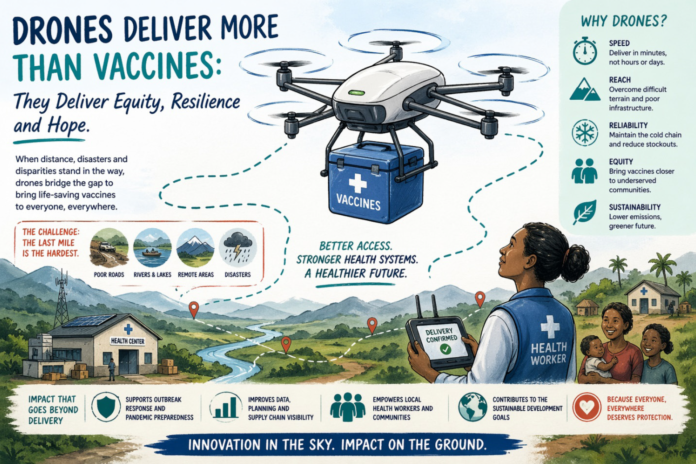
In an era of unprecedented technological advancement, it is no longer acceptable that geography, poor infrastructure, or fragile logistics determine who gets vaccinated and who does not. Drone technology (unmanned aerial vehicles, UAVs) challenges this paradigm. The question is no longer whether drones can deliver vaccines—but whether we are willing to fully integrate them into health systems at scale.
Breaking the Tyranny of Distance:
For decades, vaccine delivery has depended on roads that do not exist, vehicles that break down, and supply chains that fail under pressure. In many low- and middle-income countries (LMICs), reaching remote communities can take hours—or days.
Drones fundamentally disrupt this model. They bypass terrain, deliver directly, and operate on demand. Countries such as Ghana and Rwanda have demonstrated that national drone delivery networks are not futuristic concepts—they are operational realities. These systems have already delivered millions of medical products, including vaccines, to previously hard-to-reach populations.
If we can deliver packages across continents overnight, why are we still unable to reliably deliver vaccines within our own countries?
From Stockouts to Precision Delivery:
One of the most overlooked failures in immunization programs is not vaccine hesitancy—it is vaccine absence. Stockouts at peripheral health facilities remain a major driver of missed opportunities for vaccination.
Drone-enabled systems allow for real-time, on-demand resupply, reducing dependence on periodic distribution cycles. This transforms vaccine logistics from a “push” system to a responsive, data-driven “pull” system, indeed more pragmatic. Evidence shows that drone delivery can significantly reduce stockout duration and improve availability of essential vaccines.
Moreover, smaller, more frequent deliveries reduce the need for large local storage, minimizing wastage and improving cold chain integrity—particularly critical for temperature-sensitive vaccines.
Equity Is a Logistics Problem, but Why?
Global vaccination inequities are often framed as issues of access, demand, or policy. But at their core, they are also logistics failures.
Drones offer a powerful tool to address these inequities. By reaching remote, rural, and underserved populations, they help close the gap between urban and rural health services. Modeling studies suggest that drone-supported supply chains can increase vaccine availability and coverage in geographically challenging settings.
In this sense, drones are not just a technological innovation—they are an equity intervention.
Speed Matters: Outbreaks, Emergencies, and Lives Saved (not only “Micro Science”):
In outbreak scenarios, time is everything. Delays in vaccine delivery translate directly into preventable infections and deaths.
Drones can deliver vaccines and medical supplies in minutes rather than hours, enabling rapid response to emerging health threats. Their independence from road infrastructure makes them particularly valuable in disaster zones, conflict settings, and during epidemics.
If pandemic preparedness is truly a global priority, then drone logistics must be part of the conversation—not an afterthought.
Vaccines, Climate Change, and Sustainable Health Systems:
Ironically, the same systems that struggle to deliver vaccines are also vulnerable to climate change. Floods, extreme weather, and environmental degradation increasingly disrupt traditional supply chains.
Drone delivery systems—often electric and low-emission—offer a more resilient and environmentally sustainable alternative. By reducing reliance on ground transport, they can lower carbon emissions while maintaining continuity of care.
This aligns with the growing need for climate-smart health systems, where innovation supports both health outcomes and environmental sustainability.
Cost: Barrier or Excuse?
A common argument against drone deployment is cost. However, this perspective often reflects short-term thinking.
While initial investments may be significant, evidence suggests that drone delivery can be cost-effective at scale, particularly when accounting for reduced wastage, improved efficiency, and avoided health system costs.
The real question is not whether we can afford drones—but whether we can afford not to invest in systems that prevent missed vaccinations and save lives.
The Real Barriers: Policy, Perception, and Prioritization, a Political Concern (?):
Despite strong evidence and successful implementations, drone adoption remains uneven. The barriers are rarely technological; they are political, regulatory, and perceptual.
- Fragmented regulatory frameworks
- Limited integration into national immunization strategies
- Perception of drones as “pilot projects” rather than core infrastructure
- Uncertain financing and procurement mechanisms
- In other words, the challenge is not innovation, it is implementation at scale.
Conclusion: From Innovation to Standard of Care:
Drone technology has moved beyond proof of concept. It is already saving time, improving access, and strengthening health systems. Yet its full potential remains underutilized.
If we are serious about achieving equitable immunization coverage, strengthening pandemic preparedness, and building resilient health systems, we must move drones from the margins to the mainstream.
The future of vaccine delivery will not be defined by what we can invent—but by what we choose to implement.
Bibliography:
- Griffith EF, Boateng GO, Smith EA. The use of drones to deliver vaccines in Africa. Vaccines (Basel). 2023;11(3):592. doi:10.3390/vaccines11030592
- Kolter M, Li J, Luo Y. Designing drone delivery networks for vaccine supply chains. arXiv. 2022;arXiv:2208.04357.
- Nyaaba AA, Saito O, Otsuki K. Intricacies of medical drones in healthcare delivery. Technol Forecast Soc Change. 2021;169:120984. doi:10.1016/j.techfore.2021.120984
- Ospina-Fadul MJ, Kremer P, Stevens SE, Haruna F, Okoh-Owusu M, Sarpong GK, Osei-Kwakye K, Joshua B, Sakyi O. Cost-Effectiveness of Aerial Logistics for Immunization: A Model-Based Evaluation of Centralized Storage and Drone Delivery of Vaccines in Ghana Using Empirical Data. Value Health Reg Issues. 2025 Mar;46:101066. doi: 10.1016/j.vhri.2024.101066.
- Amukele T, Ness PM, Tobian AA, Boyd J, Street J. Drone transportation of blood products. Transfusion. 2017 Mar;57(3):582-588. doi: 10.1111/trf.13900.
- Gavi, the Vaccine Alliance. Drone delivery systems for vaccines. chrome-extension://efaidnbmnnnibpcajpcglclefindmkaj/https://fii-institute.org/wp-content/uploads/2024/08/TL2406_001_VaccinationDistribution.pdf
- World Health Organization. Immunization supply chain and logistics. Geneva: WHO; 2020. https://www.who.int/publications/i/item/WHO-IVB-14.05.
- Enayati S, Campbell JF, Li H. Vaccine distribution with drones for less developed countries: A case study in Vanuatu. Vaccine X. 2023 May 15;14:100312. doi: 10.1016/j.jvacx.2023.100312.
- Sayarshad HR. Equity-based vaccine delivery by drones: Optimizing distribution in disease-prone regions. Transp Res Part E Logist Transp Rev. 2025;195:103979. https://doi.org/10.1016/j.tre.2025.103979.
- Singh T, Sinjana Y, Kapoor AP. Aerial innovations in healthcare: A systematic review of drone-based logistics and regulatory barriers. Sustainable Futures 2026;11:101758. https://doi.org/10.1016/j.sftr.2026.101758.