
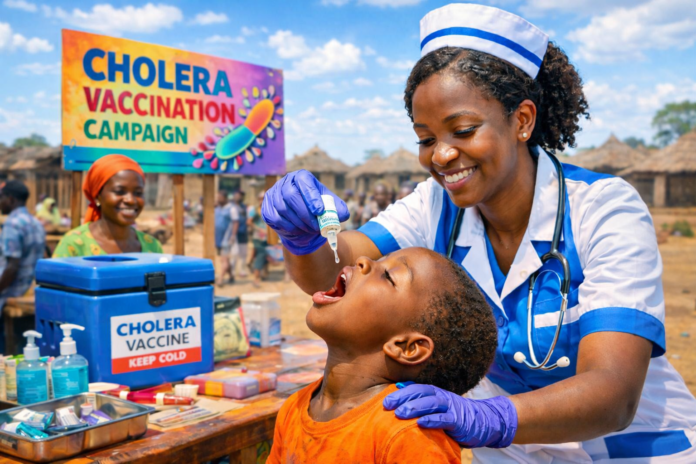
Introduction:
The global cholera situation continues to worsen, driven by conflict, poverty, and fragile health systems, and now represents a major public health emergency across several WHO regions. Between 1 January and 17 August 2025, 409,222 cholera or Acute Watery Diarrhoea (AWD) cases and 4,738 deaths were reported in 31 countries. Alarmingly, six of these countries recorded case-fatality rates above 1%, highlighting serious gaps in case management, timely access to care, and essential health services.
Cholera is resurging in nations that have not seen substantial transmission in years—such as Chad and the Republic of Congo—while other countries, including the Democratic Republic of the Congo, South Sudan, and Sudan, continue to experience large, expanding outbreaks originating from 2024. This sustained geographic spread complicates containment efforts and places intense pressure on already overstretched health systems.
Multiple overlapping crises are fueling this deterioration. Conflict, mass displacement, natural disasters, and climate change have significantly increased vulnerability, especially in rural and flood-affected communities where water and sanitation infrastructure is limited. These conditions delay treatment, disrupt surveillance, and accelerate transmission. Cross-border population movement has further increased the complexity of outbreaks, making them harder to predict, control, and contain.
Long-term control relies on safe drinking water, sanitation, and hygiene (WASH)—the only sustainable solution to ending recurrent cholera emergencies. However, given the current scale and interconnected nature of outbreaks, the risk of continued and expanded transmission remains very high. Without urgent, coordinated, and multisectoral action, cholera is likely to spread further across borders.
A comprehensive response is underway. WHO is working closely with Ministries of Health and partners to strengthen surveillance, reinforce laboratory capacity, improve the availability and quality of treatment, implement effective WASH and infection-prevention measures, enhance community engagement, and facilitate access to oral cholera vaccines (OCV) and campaign rollout.
On 26 August 2025, Africa CDC and WHO jointly launched the Continental Cholera Emergency Preparedness and Response Plan for Africa 1.0, supported by a coordinated Incident Management Team. This initiative builds on the recent Call to Action by African Heads of State and Government, who have elevated cholera to a continental priority and pledged to control and eliminate outbreaks by 2030.
Types of Cholera Vaccines:
1. Killed Whole-Cell Oral Cholera Vaccines (kOCVs)
Examples: Shanchol®, Euvichol®, Euvichol-Plus® (including the simplified Euvichol-S formulation)
Killed whole-cell OCVs form the foundation of global cholera prevention and control efforts. These vaccines contain inactivated Vibrio cholerae O1 (and in some formulations, O139) bacteria that stimulate protective mucosal and systemic immune responses without risk of infection.
Key characteristics:
- Primary tool for endemic and outbreak settings, endorsed by WHO for all ages ≥1 year.
- Two-dose regimen provides optimal and long-lasting protection, with immunity lasting up to 5 years in many settings.
- Single-dose strategy offers meaningful short-term protection and is often used during emergencies or when vaccine supply is limited.
- Extensively deployed through the global Oral Cholera Vaccine Stockpile, with millions of doses administered in high-risk regions across Africa and Asia.
- Newer formulations like Euvichol-S® aim to increase production capacity and reduce costs, addressing chronic global supply shortages.
2. Live Attenuated Oral Cholera Vaccine
Example: Vaxchora® (CVD 103-HgR)
Live attenuated vaccines contain a genetically weakened strain of Vibrio cholerae that triggers strong intestinal immunity, closely mimicking natural infection.
Key characteristics:
- Licensed primarily for travelers in the United States and several other high-income countries.
- Single-dose regimen provides rapid onset of protection—typically within 10 days—making it ideal for short-notice travel.
- Demonstrates high short-term efficacy, particularly against severe diarrhea caused by V. cholerae O1 Ogawa.
- Not used for mass campaigns or outbreak response due to cost, limited supply, and lack of WHO prequalification.
- Offers a distinct immunologic profile with robust mucosal IgA responses, but duration of immunity is generally shorter than that of kOCVs.
Cholera Vaccines: Current Evidence and Future Directions:
Oral cholera vaccines (OCVs) are essential tools for protecting travelers to cholera-endemic regions and for controlling outbreaks. They provide substantial protection, particularly with the full two-dose regimen—against moderate to severe cholera, although effectiveness decreases over time and is lower in young children (<5 years). Global use relies heavily on WHO-prequalified vaccines such as Shanchol® and Euvichol®, though supply constraints continue to challenge response capacity.
Systematic reviews consistently show strong vaccine performance: individuals receiving OCVs are 4.5 times less likely to develop severe cholera, and two-dose regimens demonstrate up to 80% efficacy at five years. However, reviews highlight ongoing needs for expanded supply, simplified regimens, and improved protection for young children.
Key Findings from Reviews and Field Studies:
Effectiveness:
- Two-dose OCV schedules show long-lasting protection, with efficacy up to 80% at 5 years.
- One-dose regimens provide meaningful short-term protection but wane more quickly.
Severity Reduction:
- OCVs substantially reduce the risk of severe cholera, an important outcome for preventing mortality.
Age-Related Effectiveness:
- Vaccine performance is significantly lower in children under 5 years, who remain among the most vulnerable.
Use Cases:
- Effective in both endemic settings and outbreak response, with strong real-world evidence supporting their impact.
Challenges and Future Directions:
Supply Limitations
- Demand frequently exceeds the global stockpile, complicating timely outbreak response.
Operational Constraints
- Two-dose schedules can be logistically challenging during emergencies.
- This has spurred interest in single-dose strategies for rapid protection.
Vaccine Development Priorities:
- Heat-stable formulations to support remote or high-temperature settings.
- Single-dose or improved short-interval regimens to simplify deployment.
- Next-generation vaccines such as Euvichol-S® to expand manufacturing capacity.
- Ongoing African vaccine production initiatives aimed at regional self-sufficiency.
Conclusions:
Cholera vaccination remains a critical public-health intervention, particularly in the context of the expanding global outbreaks seen across Africa, the Middle East, and South Asia. WHO currently recommends oral cholera vaccines (OCVs) for two major indications:
- Outbreak Response:
OCVs are a core component of rapid response strategies. They reduce transmission, protect high-risk communities, and help stabilize health systems during active epidemics. A single-dose regimen is often used when vaccine supply is limited, providing meaningful short-term protection while enabling wider population coverage. - Prevention in Endemic Areas:
Populations living in regions with recurrent or seasonal transmission benefit from full two-dose OCV schedules, which offer longer and stronger protection, reduce disease burden, and mitigate the risk of severe illness.
In the current global context—marked by conflict-driven displacement, climate-related disasters, and deteriorating water and sanitation systems—the role of cholera vaccination is more essential than ever. However, vaccination alone cannot end outbreaks. Sustainable control requires integration with safe water, sanitation, hygiene (WASH) interventions, strengthened surveillance, rapid case management, and cross-border coordination.
Overall, cholera vaccines serve as an indispensable, rapidly deployable tool for outbreak containment and population protection—buying critical time while long-term infrastructure solutions are implemented.
Bibliography:
- World Health Organization. Cholera vaccine: WHO position paper, August 2017 – Recommendations. Vaccine. 2018 Jun 7;36(24):3418-3420. doi: 10.1016/j.vaccine.2017.09.034.
- Chowdhury F, Ross AG, Islam MT, McMillan NAJ, Qadri F. Diagnosis, Management, and Future Control of Cholera. Clin Microbiol Rev. 2022 Sep 21;35(3):e0021121. doi: 10.1128/cmr.00211-21.
- Kanungo S, Azman AS, Ramamurthy T, Deen J, Dutta S. Cholera. Lancet. 2022 Apr 9;399(10333):1429-1440. doi: 10.1016/S0140-6736(22)00330-0.
- Deen J, Mengel MA, Clemens JD. Epidemiology of cholera. Vaccine. 2020 Feb 29;38 Suppl 1:A31-A40. doi: 10.1016/j.vaccine.2019.07.078.
- Mogasale V, Ramani E, Wee H, Kim JH. Oral Cholera Vaccination Delivery Cost in Low- and Middle-Income Countries: An Analysis Based on Systematic Review. PLoS Negl Trop Dis. 2016 Dec 8;10(12):e0005124. doi: 10.1371/journal.pntd.0005124.
- Bekolo CE, van Loenhout JA, Rodriguez-Llanes JM, Rumunu J, Ramadan OP, Guha-Sapir D. A retrospective analysis of oral cholera vaccine use, disease severity and deaths during an outbreak in South Sudan. Bull World Health Organ. 2016 Sep 1;94(9):667-674. doi: 10.2471/BLT.15.166892.
- CDC: Cholera Vaccine: Recommendations of the Advisory Committee on Immunization Practices, 2022. Accessed January 10, 2026. https://www.cdc.gov/mmwr/volumes/71/rr/rr7102a1.htm#:~:text=CVD%20103%2DHgR%20is%20a,the%20United%20States%20%2819%29.
- Edosa M, Jeon Y, Gedefaw A, Hailu D, Mesfin Getachew E, Mogeni OD, Jang GH, Mukasa D, Yeshitela B, Getahun T, Lynch J, Bouhenia M, Worku Demlie Y, Hussen M, Wossen M, Teferi M, Park SE. Comprehensive Review on the Use of Oral Cholera Vaccine (OCV) in Ethiopia: 2019 to 2023. Clin Infect Dis. 2024 Jul 12;79(Suppl 1):S20-S32. doi: 10.1093/cid/ciae194.
- Saif-Ur-Rahman KM, Mamun R, Hasan M, Meiring JE, Khan MA. Oral killed cholera vaccines for preventing cholera. Cochrane Database Syst Rev. 2024 Jan 10;1(1):CD014573. doi: 10.1002/14651858.CD014573.
- Xu H, Tiffany A, Luquero FJ, Kanungo S, Bwire G, Qadri F, Garone D, Ivers LC, Lee EC, Malembaka EB, Mendiboure V, Bouhenia M, Breakwell L, Azman AS. Protection from killed whole-cell cholera vaccines: a systematic review and meta-analysis. Lancet Glob Health. 2025 Jul;13(7):e1203-e1212. doi: 10.1016/S2214-109X(25)00107-X.
- Ogunniyi TJ, Muoneke AP, Nimo F, Yisa SS, Olorunfemi OA. Cholera in Nigeria: a five-decade review of outbreak dynamics and health system responses. J Health Popul Nutr. 2025 Sep 29;44(1):329. doi: 10.1186/s41043-025-01096-7.
- Stout RC, Feasey N, Péchayre M, Thomson N, Chilima BZ. Time to invest in cholera. EClinicalMedicine. 2025 Jan 18;80:103044. doi: 10.1016/j.eclinm.2024.103044.
- Im J, Islam MT, Ahmmed F, Kim DR, Tadesse BT, Kang S, Khanam F, Chowdhury F, Ahmed T, Firoj MG, Aziz AB, Hoque M, Jeon HJ, Kanungo S, Dutta S, Zaman K, Khan AI, Marks F, Kim JH, Qadri F, Clemens JD. Do Oral Cholera Vaccine and Water, Sanitation, and Hygiene Combine to Provide Greater Protection Against Cholera? Results From a Cluster-Randomized Trial of Oral Cholera Vaccine in Kolkata, India. Open Forum Infect Dis. 2024 Jan 10;11(1):ofad701. doi: 10.1093/ofid/ofad701.