


Pilar Rubio. MD, MHA. Medical Director LATAM, Biological E. Limited. Otavio Cintra. 2. MD, PhD. Pediatric Infectious Diseases Specialist. Independent consultant, Biological E. Limited. Marjorie Vásquez. DVM, MSc. Veterinarian and Master in Epidemiology. Independent Consultant, Biological E. Limited.
In recent years, the National Immunization Program (NIP) in Latin America and the Caribbean (LAC) has expanded rapidly through the inclusion of new vaccines (PAHO n.d.). However, the increase in expenditure, driven by the incorporation of high-cost vaccines, is not resolving and at times conceals the weakening of the pillars that have sustained the success of NIP: high and sustained coverage together with robust epidemiological surveillance.
More investment does not guarantee greater impact if the foundations of NIP are weakened.
Countries in LAC are incorporating increasingly expensive vaccines, while the operational base that ensures health outcomes—such as sustained and homogeneous coverage, completion of schedules (particularly booster doses), and surveillance systems capable of measuring impact—has been eroding year after year (PAHO n.d.). Recent outbreaks of measles and pertussis are clear examples of the vulnerability of NIP in the region (PAHO, 2026a).
Low immunization coverage, coupled with deficient surveillance systems, not only poses health risks to the population but also undermines confidence in the achievements attained thus far (PAHO n.d.).
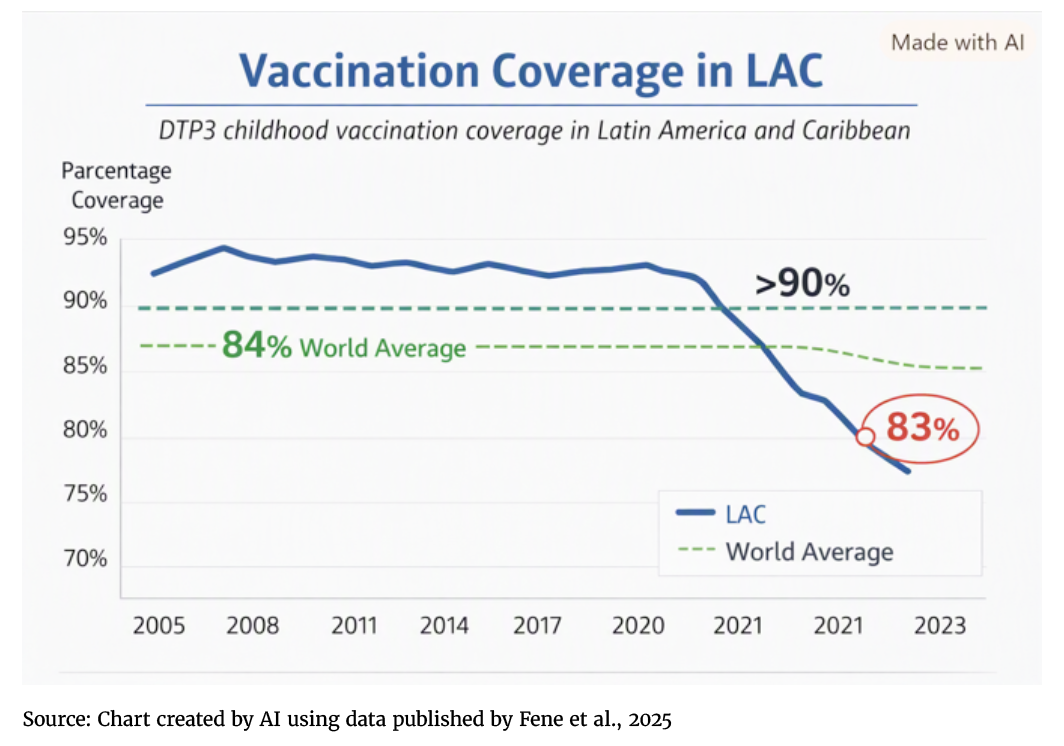
The region has lost its historical advantage in coverage. Basic childhood vaccination coverage in LAC fell to 83% in 2023, below the global average (84%) and far below the >90% sustained for 17 years. Although coverage has been slowly increasing, it remains far from the 95% target. It is estimated that ~1.7 million children are “zero-dose” and ~2 million remain vulnerable to vaccine-preventable diseases (PAHO, 2026b; Fene et al., 2025).
This decline coincided with the era of new vaccines. The Global Burden of Disease 2020 analysis found that between 2010 and 2019—the period of successful introduction and scale-up of new vaccines—increases in routine vaccine coverage were minimal, with LAC showing particularly striking stagnation (GBD 2020, Release 1, Vaccine Coverage Collaborators, 2021). The pandemic further exacerbated this problem, and countries have yet to reach expected levels (PAHO, 2026a; PAHO, 2026b; PAHO, 2026c). It is possible that focus was lost as efforts shifted toward implementing new vaccines, which, while necessary, must be introduced with the support of methodologically sound data and studies (PAHO, 2026f).
Unfortunately, the trend persists. GBD 2023 identifies LAC among the regions that must reverse recent declines to recover previous levels, particularly in DTP1, DTP3, and Pol3. Coverage remains below required thresholds (GBD 2023 Vaccine Coverage Collaborators, 2025).
Pediatric protection does not end with the primary series.
PAHO has recommended monitoring coverage of the primary series of 17 childhood vaccines as a direct indicator of NIP performance. Management considers dropout rates, defined as the percentage of the population that, after initiating a schedule, does not complete the required doses according to the recommended calendar. Currently, coverage of second and third doses of vaccines such as DTP, pneumococcus, polio, and measles is affected by dropout rates across LAC (GBD 2023 Vaccine Coverage Collaborators, 2025; PAHO, 2026b).
Pediatric vaccine booster doses—administered during the second year of life and at school age — are essential for achieving both direct and collective protection (herd immunity) against vaccine-preventable diseases; yet, regrettably, they are not included among management indicators (WHO, 2025). Paradoxically, the most significant drops in coverage occur with these booster doses in the region (PAHO, 2026b). Given this situation, a regional group of experts has emphasized the importance of increasing coverage for childhood vaccine boosters and strengthening surveillance, both of which are necessary to prevent the re-emergence of diseases that can be averted in infants, regardless of whether or not these doses are used as management benchmarks (Ávila et al., 2023; WHO, 2025).
More budget does not equal more coverage.
An analysis of vaccination coverage trends in LAC and their relationship with government financing found a moderate association between gross national income per capita and vaccination coverage, and a weak-to-moderate correlation between vaccine expenditure and DTP3 coverage rates. In 2017, despite self-sufficiency in vaccine financing, fewer countries achieved 90% coverage in five vaccines compared to 2013 (Llau et al., 2021).
The purchase of new vaccines, even the most expensive, does not automatically buy the capacity to deliver them fully and equitably. Coverage depends on the strength of primary health care, public trust, logistical capacity, and cold chain systems—not necessarily on increased budgets for expanding with higher-cost vaccines (PAHO, 2026c; PAHO, 2026f).
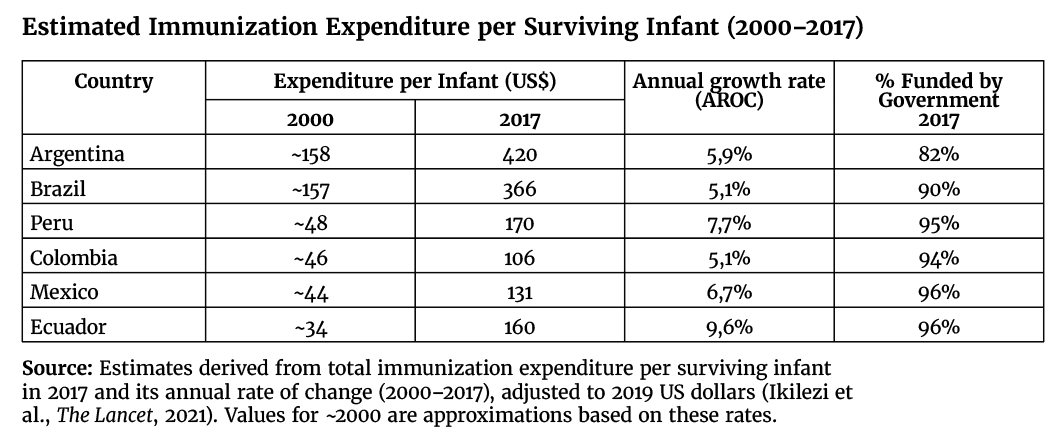
Expenditure on childhood immunization has grown steadily.
LAC became the region with the highest spending per surviving infant in 2017: US$213 (range 187–243), with governments financing nearly all this expenditure (Ikilezi et al., 2021). Between 2000 and 2017, spending grew at annual rates of 5–10% depending on the country, meaning several countries doubled or tripled their investment per infant in less than two decades (Ikilezi et al., 2021).
Despite this, coverage stagnated or declined—a paradox that demands scrutiny of how investments are executed. Indeed, LAC is among the regions where, in a significant proportion of countries, coverage of vaccines such as pentavalent or measles decreased while government spending increased (Ikilezi et al., 2021).
The following table illustrates the magnitude of the increase, comparing the total immunization expenditure per surviving infant (in 2019 US dollars, adjusted for inflation) estimated for the year 2000 versus 2017 in selected countries
Spending has doubled or tripled, but coverage has either declined or stagnated—a paradox that necessitates a review of how investments are implemented. In fact, Latin America and the Caribbean (LAC) is among the regions where, in many countries, coverage for vaccines such as the pentavalent or measles vaccine has decreased, even as government spending has risen (Ikilezi et al., 2021). The public health imperative to maintain vaccination coverage above 95% has been lost
In parallel, some countries have opted to include higher-valency pneumococcal conjugate vaccines (PCVs) in pediatric populations without thoroughly assessing the real health gains of the additional serotypes. The potential population benefit of a PCV depends not only on the number of serotypes included, but also on the frequency, invasiveness, and disease burden associated with those serotypes in each country under evaluation (Lagousi et al., 2021).
Systematic reviews of economic evaluations of pediatric PCVs highlight variations in models, vaccination strategies, assumptions, and conclusions, underscoring the importance of considering local epidemiology, vaccine prices, analytical perspective, and uncertainty when interpreting results (Vo et al., 2024; Shono et al., 2025). Conventional cost-effectiveness outcomes must be interpreted alongside total program expenditure, net monetary benefit, uncertainty, affordability, and opportunity costs (Mauskopf et al., 2018).
Thus, the economic value of expanded serotype coverage cannot be generalized across settings based solely on valency, especially in pediatric vaccination. In practice, this often translates into significant expenditures for products whose real public health benefit is not always demonstrated, while basic coverage continues to decline (ISPPD, 2026; Principi et al., 2025).
Without adequate surveillance, there is no way to measure impact.
Several LAC countries have seen their epidemiological surveillance systems weaken due to insufficient financial resources. Small expert groups have managed to secure short-term funding, but these efforts are not enough to sustain comprehensive systems. This leaves countries without adequate data for evidence-based decision-making (PAHO, 2026f). The most concerning aspect is that costly vaccines are being adopted without updated epidemiological diagnostics to evaluate their health impact (PAHO, 2026c; PAHO, 2026d).
This is the most critical consequence for public health decision-making. In many settings, it is not possible to measure vaccination impact due to lack of investment in strengthening health information systems and surveillance. Networks such as rotavirus surveillance and pneumococcal initiatives have been precisely those that documented vaccine impact and supported investment before governments and funders (PAHO, 2026f). Currently, several countries lack updated, real-time information. This is another paradox: countries invest in more expensive vaccines without investing in surveillance and therefore cannot demonstrate whether adopted decisions were correct. Inconsistent surveillance quality and data scarcity force reliance on mathematical models to estimate impact (Li et al., 2021). Health impact becomes invisible, and what is invisible cannot be defended or financed in the long term (PAHO, 2026f).
The Proposal: Evidence-based expansion and vaccination coverage
Restore coverage levels to 95% for NIP vaccines in LAC, including both primary series and childhood booster doses (WHO, 2025).
Invest in strengthening surveillance as the foundation for health decision-making and evaluation of strategies adopted according to epidemiology of vaccine-preventable diseases (PAHO, 2026f).
Condition each new vaccine introduction on simultaneous strengthening of coverage, cold chain, electronic vaccination registries, and surveillance (Ávila Agüero et al., 2023).
Prioritize subnational equity and zero-dose children, where lack of vaccination overlaps with other health service gaps (Fene et al., 2025).
Integrate immunization information systems to ensure reliable denominators and disaggregated data (Velandia et al., 2021).
The challenge for the next decade in LAC NIP will not only be how many new vaccines are included, but how the foundations are strengthened: coverage of primary series and boosters, and robust surveillance systems.
Referencias bibliográficas
- Organización Panamericana de la Salud. (s. f.). Tablero de seguimiento del RIAP2030: Plan de acción regional sobre inmunización para las Américas 2030 (Versión 1.2.6) [Tablero interactivo]. Organización Mundial de la Salud. Recuperado el 15 de octubre de 2026, de https://paho-cim.shinyapps.io/riap2030-dashboard/
- Organización Panamericana de la Salud. (2026a). La OPS llama a reforzar la vacunación ante el aumento de casos de sarampión en las Américas. https://www.paho.org/es/noticias/23-4-2026-ops-llama-reforzar-vacunacion-ante-aumento-casos-sarampion-americas
- Fene, F., Johri, M., Michel, M. E., Reyes-Morales, H., & Pelcastre-Villafuerte, B. E. (2025). Multiple deprivations as determinants of suboptimal basic child vaccination in Latin America and the Caribbean: Cross-sectional analysis of household survey data of 18,136 children in 211 regions across 15 countries. International Journal for Equity in Health, 24(1), Artículo 184. https://doi.org/10.1186/s12939-025-02561-9
- Organización Panamericana de la Salud. (2026b). PAHO/WHO Immunization coverage in the Americas. https://paho-cim.shinyapps.io/immunization-dashboard/
- Organización Panamericana de la Salud. (2026c). Orientaciones para la microplanificación de actividades de vacunación. https://www.paho.org/es/documentos/orientaciones-para-microplanificacion-actividades-vacunacion
- GBD 2020, Release 1, Vaccine Coverage Collaborators. (2021). Measuring routine childhood vaccination coverage in 204 countries and territories, 1980–2019: A systematic analysis for the Global Burden of Disease Study 2020, Release 1. The Lancet, 398(10299), 503–521. https://doi.org/10.1016/S0140-6736(21)00984-3
- GBD 2023 Vaccine Coverage Collaborators. (2025). Global, regional, and national trends in routine childhood vaccination coverage from 1980 to 2023 with forecasts to 2030: a systematic analysis for the Global Burden of Disease Study 2023. The Lancet, 406(10500), 235–260. https://doi.org/10.1016/S0140-6736(25)01037-2
- Llau, A. F., Williams, M. L., & Espinal Tejada, C. (2021). National vaccine coverage trends and funding in Latin America and the Caribbean. Vaccine, 39(2), 317–323. https://doi.org/10.1016/j.vaccine.2020.11.059
- Organización Panamericana de la Salud. (2026d). Precios vacunas 2026 del Fondo Rotatorio. https://www.paho.org/es/documentos/precios-vacunas-2026-fondo-rotatorio
- Organización Mundial de la Salud. (2025). WHO recommendations for routine immunization —summary tables. https://www.who.int/teams/immunization-vaccines-and-biologicals/policies/who-recommendations-for-routine-immunization—summary-tables
- Ikilezi, G., Micah, A. E., Bachmeier, S. D., Cogswell, I. E., Maddison, E. R., Stutzman, H. N., Tsakalos, G., Brenzel, L., & Dieleman, J. L. (2021). Estimating total spending by source of funding on routine and supplementary immunization activities in low-income and middle-income countries, 2000–17: A financial modelling study. The Lancet, 398(10314), 1875–1893. https://doi.org/10.1016/S0140-6736(21)01591-9
- ISPPD. (2026). Extended valency pneumococcal vaccines: Opportunities and immunological challenges [Sesión de conferencia]. ISPPD 2026: 13th International Symposium on Pneumococcal and Pneumococcal Diseases. https://transcripts.kenes.com/isppd26/82
- Principi N, Argetiero A, Campana B, Esposito S. PCV20 in pediatric pneumococcal prevention: expanded coverage, remaining challenges. Frontiers in Immunology. 2025.
- Avila Agüero, M. L., Castillo, J. B. D., Falleiros-Arlant, L. H., Berezín, E., de Moraes, J. C., Torres-Martínez, C., … López-Medina, E. (2023). Risks of low vaccination coverage and strategies to prevent the resurgence of vaccine-preventable diseases in infants in the COVID-19 pandemic scenario: recommendations for Latin America and the Caribbean by the group of experts on infant immunization for Latin America. Expert Review of Vaccines, 22(1), 1091–1101. https://doi.org/10.1080/14760584.2023.2271057
- Li, X., Mukandavire, C., Cucunubá, Z. M., Echeverria Londono, S., Abbas, K., Clapham, H. E., Jit, M., Johnson, H. L., Papadopoulos, T., Vynnycky, E., Brisson, M., Carter, E. D., Clark, A., de Villiers, M. J., Eilertson, K., Ferrari, M. J., Gamkrelidze, I., Gaythorpe, K. A. M., Grassly, N. C., … Garske, T. (2021). Estimating the health impact of vaccination against ten pathogens in 98 low-income and middle-income countries from 2000 to 2030: a modelling study. The Lancet, 397(10272), 398–408. https://doi.org/10.1016/S0140-6736(20)32657-X
- Organización Panamericana de la Salud. (2026f). Mejores inversiones para acelerar la eliminación de enfermedades en la Región de las Américas: Intervenciones transversales por líneas de acción de la Iniciativa para la Eliminación de Enfermedades. Washington, D. C. https://www.paho.org/es/temas/inmunizacion#cases
- Velandia-González, M., Vilajeliu, A., Contreras, M., Trumbo, S. P., Pacis, C., Ropero, A. M., & Ruiz-Matus, C. (2021). Monitoring progress of maternal and neonatal immunization in Latin America and the Caribbean. Vaccine, 39(33), 4707–4714. https://doi.org/10.1016/j.vaccine.2020.12.007
- Lagousi, T., Papadatou, I., Strempas, P., Chatzikalil, E., & Spoulou, V. (2021). Pneumococcal immunization strategies for high-risk pediatric populations worldwide: One size does not fit all. Vaccines, 9(12), Artículo 1390. https://doi.org/10.3390/vaccines9121390
- Vo, N. X., Pham, H. L., Bui, U. M., Ho, H. T., & Bui, T. T. (2024). Cost-effectiveness analysis of pneumococcal vaccines in the pediatric population: A systematic review. Healthcare, 12(19), Artículo 1950. https://doi.org/10.3390/healthcare12191950
- Shono, A., Hoshi, S. L., & Kondo, M. (2025). Cost-effectiveness analyses of 20-valent pneumococcal conjugate vaccine in children and adults: A narrative review. Human Vaccines & Immunotherapeutics, 21(1). https://doi.org/10.1080/21645515.2025.2525619
- Mauskopf, J., Standaert, B., Connolly, M. P., Culyer, A. J., Garrison, L. P., Hutubessy, R., Jit, M., Pitman, R., Revill, P., & Severens, J. L. (2018). Economic analysis of vaccination programs: An ISPOR good practices for outcomes research task force report. Value in Health, 21(10), 1133–1149. https://doi.org/10.1016/j.jval.2018.08.005