
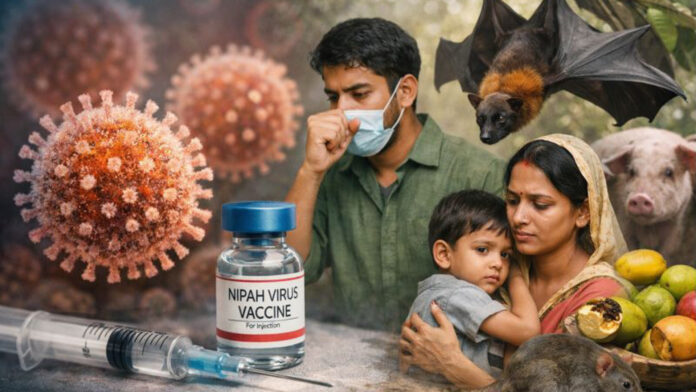
Nipah Virus Overview
- Nipah virus (Henipavirus nipahense, NiV) is a zoonotic, single-stranded, negative-sense RNA virus in the genus Henipavirus, family Paramyxoviridae.
- First identified in Malaysia and Singapore in 1999, primarily affecting pig farmers and abattoir workers.
- Causes severe neurological and respiratory disease, ranging from fever and headache to acute encephalitis.
Clades and Geographic Patterns
NiV-Malaysia (NiVM) clade
- Responsible for Malaysia and Singapore outbreaks.
- Spread mainly through infected pigs.
- No sustained person-to-person transmission observed.
NiV-Bangladesh (NiVB) clade
- Associated with recurring outbreaks in Bangladesh and India since 2001.
- High person-to-person transmission:
- ~29% of cases in Bangladesh
- 50% of cases in India
- Much higher transmissibility than NiVM.
NiV-India clade
- A distinct phylogenetic lineage identified in India.
- Not yet formally classified as separate from NiVB.
Transmission Routes
Zoonotic spillover primarily linked to:
- Consumption of raw date palm sap contaminated by bat excreta (Bangladesh, India).
- Close contact with infected pigs (Malaysia, Singapore).
In the Philippines (2014):
- Transmission associated with slaughter/consumption of infected horses and subsequent human-to-human spread.
- Reservoir hosts include Pteropus medius fruit bats.
Incubation Period and Disease Course
Malaysia:
- 4 days to 2 months; 92% of cases ≤14 days.
Bangladesh:
- Typically 6–11 days.
Disease progression is rapid:
- Mean time from symptom onset to death is ~8 days (range 3–31 days).
Case Fatality Rates
Extremely high mortality:
- ~78% in Bangladesh.
- ~93% in India.
- There are no antivirals for NiV.
Clinical and Pathophysiological Features
Broad cellular tropism, infecting:
- Endothelial cells
- Neuronal cells
- Respiratory epithelial cells [Citation18–21]
Severe cases characterized by encephalitis, respiratory distress, and multiorgan involvement.
Key Viral Glycoproteins (Targets for Vaccines)
Attachment glycoprotein (G):
- Binds to ephrin-B2 and ephrin-B3 receptors [Citation24–26].
Fusion glycoprotein (F):
- Mediates membrane fusion and viral entry.
Both glycoproteins are central platforms for vaccine development.
Epidemiology:
Since 1998 NiV outbreaks have been reported in Bangladesh, India, Malaysia, the Philippines, and Singapore. In India, NiV infections have occurred multiple times since 2001 with outbreaks in West Bengal State in 2001 and 2007, and in Kerala State regularly since 2018. Since 2018, Kerala has reported a total of nine NiV outbreaks.
Outbreaks during 2025:
India: Between 17 May and 12 July 2025, the Information and Public Relations Department, Government of Kerala through a series of official press releases informed about four confirmed NiV cases, including two deaths, due to NiV infection from two districts of Kerala State. Of the four cases, two were reported from Malappuram and two from Palakkad district. This marks the first-ever outbreak in Palakkad District. Of the four cases, one case was reported in May (with symptom onset in April) and three in July with symptom onset June (two cases), and July (one case). The sources of infection of the cases remain under investigation. None of these cases appear to be linked to each other, suggesting independent spillover events from the natural reservoir. A significant presence of fruit bats, the known reservoir for NiV has been observed in the affected areas.
Bangladesh: Between 1 January and 29 August 2025, the Bangladesh IHR NFP notified WHO of four confirmed fatal Nipah virus (NiV) infection cases that occurred at different times from four separate districts across three different divisions (Barisal, Dhaka, and Rajshahi) of Bangladesh. All cases were confirmed through Reverse Transcription Polymerase Chain Reaction (PCR) and Enzyme-Linked Immunosorbent Assay (ELISA) testing, and no epidemiological links were reported to have been identified between the cases.
The first case was a young adult woman from Pabna district, Rajshahi division, with symptom onset on 25 January. She was admitted to a community hospital on 26 January and referred to another hospital the next day. She died on 28 January, and laboratory confirmation of NiV was received on 29 January. A total of 96 contacts were reported to be identified, and all tested negative for NiV. The first three cases had a history of consuming raw palm sap. However, the fourth case had no history of consuming raw palm sap, and the likely source/s of infection remain under investigation. None of the cases appears to be linked to each other. Fruit bats, the known reservoir for NiV, are present in the affected regions.
Current Progress and Key Challenges in Developing Nipah Virus Vaccines:
There is no licensed vaccine for NiV.
Current Vaccine Candidates:
mRNA Vaccines
The mRNA-1215 vaccine is a lipid nanoparticle–formulated mRNA candidate targeting the Nipah virus Malaysia strain (NiVM) [Citation41,Citation42]. Developed by Moderna in collaboration with the NIAID Vaccine Research Center, it encodes the F (fusion) and G (attachment) glycoproteins to elicit protective immunity. A Phase 1 dose-escalation trial in healthy adults in the US (NCT05398796) evaluating safety, tolerability, and antibody responses was completed in September 2024. Preclinical studies showed strong immunogenicity, generating neutralizing antibodies against NiVM and NiVB, with cross-reactive responses to Hendra virus (HeV) in mouse models.
Inactivated Virus Vaccines
Traditional inactivated whole-virus formulations are being explored. Several candidates have shown protective efficacy in animal models, but none have yet advanced to human trials.
Viral Vector Vaccines
The ChAdOx1 NipahB vaccine is a recombinant adenoviral vector vaccine developed by the University of Oxford in collaboration with CEPI. It uses the same chimpanzee adenovirus platform as the Oxford/AstraZeneca COVID-19 vaccine, engineered to express the Nipah virus G glycoprotein to induce protective immunity. An ongoing Phase 1 clinical trial in the UK (ISRCTN87634044) is assessing safety and immunogenicity in healthy adults, evaluating both single-dose and two-dose regimens. In preclinical studies, the vaccine protected African green monkeys in a lethal challenge model, eliciting strong NiV-G–specific IgG and neutralizing antibody responses after one or two doses. These glycoprotein-specific immune responses, shown to be protective in non-human primates, are being further evaluated as secondary outcomes in the Phase 1 trial. Additionally, the University of Oxford and the International Centre for Diarrhoeal Disease Research, Bangladesh, with funding from the Coalition for Epidemic Preparedness Innovations (CEPI), have initiated a Phase 2 clinical trial in Bangladesh with this platform.
Protein Subunit Vaccines
The HeV-sG-V vaccine is a protein-subunit candidate designed to protect against both Nipah virus (Bangladesh and Malaysia strains) and Hendra virus by using the soluble Hendra G glycoprotein (HeV-sG) formulated with aluminum hydroxide adjuvant. Developed by Auro Vaccines LLC in partnership with PATH and CEPI, it has shown strong preclinical performance: in non-human primates, a single dose provided complete protection against lethal Nipah and Hendra virus challenge, generating robust neutralizing antibodies and clearing detectable viral RNA. A Phase 1 dose-escalation trial in 192 healthy adults in the US (NCT04199169) evaluated single-dose and two-dose regimens for safety, tolerability, and immunogenicity. Early findings (preprint) indicate that one dose elicited limited immune responses, whereas two doses—particularly 100 µg administered 28 days apart—generated strong neutralizing antibody responses.
Conclusions:
Although Nipah virus infection is not globally distributed and its outbreaks remain relatively localized—primarily in South and Southeast Asia—the pathogen represents a significant pandemic threat. Its zoonotic origin, recurrent spillover events from animal reservoirs (notably fruit bats of the Pteropus genus), and documented human-to-human transmission in certain clades underscore its potential for wider spread under the right ecological or sociobehavioral conditions. Most critically, Nipah virus exhibits an extremely high case-fatality rate, ranging from 40% to 75% in reported outbreaks, which elevates its risk profile considerably despite its limited geographic footprint.
A major concern is the absence of a licensed vaccine or specific antiviral therapy. This gap reflects, in part, longstanding global health inequities, where pathogens that predominantly affect low- and middle-income countries receive less investment and slower research prioritization. The lack of commercial incentives—given the sporadic and regionally confined nature of outbreaks—further delays development and underscores the need for sustained international funding, public–private partnerships, and proactive platform-based research strategies aligned with epidemic preparedness frameworks.
Fortunately, progress is accelerating. Several vaccine candidates are currently in preclinical or early clinical development, including recombinant viral-vector platforms (e.g., ChAdOx1, VSV-based constructs), subunit vaccines targeting the G glycoprotein, and mRNA candidates. This expanding pipeline, supported by organizations such as CEPI and national research institutes, offers realistic prospects for deploying a Nipah vaccine for outbreak response, ring vaccination strategies, or protection of high-risk populations in endemic regions.
Continued investment, equitable access planning, and international collaboration will be essential to ensure that once a safe and effective Nipah vaccine becomes available, it can be rapidly and fairly distributed—particularly in the regions where it is most urgently needed.
References:
- Kim S, Kang H, Skrip L, Sahastrabuddhe S, Islam A, Jung SM, Vesga JF, Endo A, Edmunds WJ, Abbas K. Progress and challenges in Nipah vaccine development and licensure for epidemic preparedness and response. Expert Rev Vaccines. 2025 Dec;24(1):183-193. doi: 10.1080/14760584.2025.2476523.
- Zhou D, Wang Y, Yao Y, Kuang W, Cheng R, Zhang G, Liu H, Li X, Chiu S, Deng Z, Zhao H. Antigenic landscape of Nipah virus attachment glycoprotein analysis reveals a protective immunodominant epitope across species. NPJ Vaccines. 2025 Nov 28;11(1):5. doi: 10.1038/s41541-025-01319-2.
- Larsen BB, McMahon T, Brown JT, Wang Z, Radford CE, Crowe JE Jr, Veesler D, Bloom JD. Functional and antigenic landscape of the Nipah virus receptor-binding protein. Cell. 2025 May 1;188(9):2480-2494.e22. doi: 10.1016/j.cell.2025.02.030.
- Rahman MM, Sultana S, Dutta P, Hossain MS, Aquib WR, Sachi S, Prince KTP, Das R, Oyshee NT, Antara AJ, Choudhury SS, Farzin A, Karim MR, Khan AKMD, Sarkar T, Chowdhury NN, Khan MA, Malek FM, Fatema U, Parvin H, Habib MN, Hasan J, Chisty NN, Alam MR, Islam MA, Niloy N, Mahmood SJB, Siddika A, Rahman MM, Chowdhury M, Qayum MO, Islam A, Hossain ME, Spiropoulou C, Shoemaker T, Rahman MZ, Banu S, Hensley L, Satter SM, Montgomery JM, Shirin T. P-586. 2025 Nipah Outbreaks in Bangladesh: Clinical Patterns, Emerging Risks, and Future Preparedness in an Expanding Epidemiologic Landscape. Open Forum Infect Dis. 2026 Jan 11;13(Suppl 1):ofaf695.800. doi: 10.1093/ofid/ofaf695.800.
- Tyagi S, Upadhyay S, Bharara T, Sahai S. Nipah virus: Preventing the next outbreak. World J Clin Cases. 2025 Apr 16;13(11):99748. doi: 10.12998/wjcc.v13.i11.99748.
- Frenck RW Jr, Naficy A, Feser J, Dickey MP, Leyva-Grado VH, Egan MA, Chen T, Eldridge JH, Sciotto-Brown S, Hermida L, Promeneur D, Luckay A, Medina H, Lazaro GA, Patel NR, Naqvi T, Broder CC, Dimitrov AS, Gast C, Mercer LD, Raine M, Andi-Lolo I, Innis BL, Aponte JJ, Hamm S, Rathi N. Safety and immunogenicity of a Nipah virus vaccine (HeV-sG-V) in adults: a single-centre, randomised, observer-blind, placebo-controlled, phase 1 study. Lancet. 2025 Dec 13;406(10521):2792-2803. doi: 10.1016/S0140-6736(25)01390-X.
- Johnson T, Jamrozik E, Hurst T, Cheah PY, Parker MJ. Ethical issues in Nipah virus control and research: addressing a neglected disease. J Med Ethics. 2024 Aug 21;50(9):612-617. doi: 10.1136/jme-2023-109469.
- Moore KA, Mehr AJ, Ostrowsky JT, Ulrich AK, Moua NM, Fay PC, Hart PJ, Golding JP, Benassi V, Preziosi MP, Broder CC, de Wit E, Formenty PBH, Freiberg AN, Gurley ES, Halpin K, Luby SP, Mazzola LT, Montgomery JM, Spiropoulou CF, Mourya DT, Parveen S, Rahman M, Roth C, Wang LF, Osterholm MT. Measures to prevent and treat Nipah virus disease: research priorities for 2024-29. Lancet Infect Dis. 2024 Nov;24(11):e707-e717. doi: 10.1016/S1473-3099(24)00262-7.
- Spengler JR, Lo MK, Welch SR, Spiropoulou CF. Henipaviruses: epidemiology, ecology, disease, and the development of vaccines and therapeutics. Clin Microbiol Rev. 2025 Mar 13;38(1):e0012823. doi: 10.1128/cmr.00128-23.
- van Doremalen N, Lambe T, Sebastian S, Bushmaker T, Fischer R, Feldmann F, Haddock E, Letko M, Avanzato VA, Rissanen I, LaCasse R, Scott D, Bowden TA, Gilbert S, Munster V. A single-dose ChAdOx1-vectored vaccine provides complete protection against Nipah Bangladesh and Malaysia in Syrian golden hamsters. PLoS Negl Trop Dis. 2019 Jun 6;13(6):e0007462. doi: 10.1371/journal.pntd.0007462.
- van Doremalen N, Avanzato VA, Goldin K, Feldmann F, Schulz JE, Haddock E, Okumura A, Lovaglio J, Hanley PW, Cordova K, Saturday G, de Wit E, Lambe T, Gilbert SC, Munster VJ. ChAdOx1 NiV vaccination protects against lethal Nipah Bangladesh virus infection in African green monkeys. NPJ Vaccines. 2022 Dec 21;7(1):171. doi: 10.1038/s41541-022-00592-9.
- WHO: Nipah Virus Infection – India. (Accessed February 15, 2026). https://www.who.int/emergencies/disease-outbreak-news/item/2025-DON577.
- WHO: Nipah Virus Infection – Bangladesh. (Accessed February 15, 2026). https://www.who.int/emergencies/disease-outbreak-news/item/2025-DON582.
- CEPI: University of Oxford launches world’s first Phase II Nipah virus vaccine trial. (Accessed February 16, 2026). https://cepi.net/university-oxford-launches-worlds-first-phase-ii-nipah-virus-vaccine-trial.
- WHO: Nipah Virus. (Accessed February 15, 2026). https://www.who.int/news-room/fact-sheets/detail/nipah-virus.