

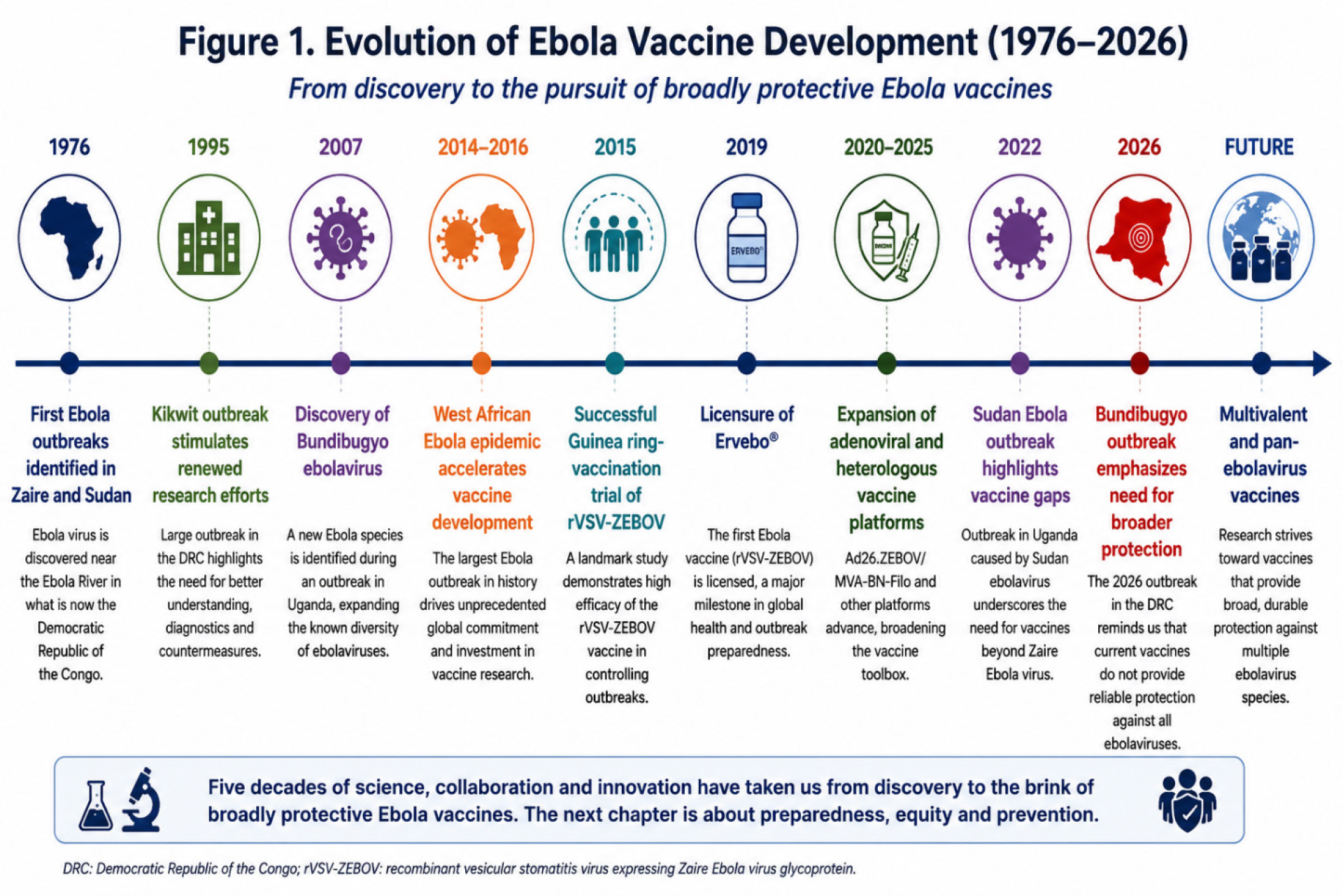
Nearly 50 years after the first recognized Ebola outbreaks in 1976, Ebola virus disease (EVD) remains one of the world’s most feared infectious diseases. Characterized by severe hemorrhagic fever, case-fatality rates that can exceed 50%, and the ability to rapidly overwhelm fragile healthcare systems, Ebola continues to pose a significant threat to global health security. The recent 2026 outbreak caused by Bundibugyo ebolavirus (BDBV) serves as a timely reminder that despite remarkable advances in vaccine development, the fight against Ebola is far from over. While effective vaccines now exist against Zaire ebolavirus (EBOV), the species responsible for the devastating West African epidemic of 2014–2016, no licensed vaccine currently provides broad protection against all ebolaviruses. The current outbreak highlights both the extraordinary achievements and the remaining challenges of Ebola vaccinology. [1,2]
From Crisis to Success: The First Generation of Ebola Vaccines
For decades after its discovery, Ebola was considered an almost untouchable target for vaccine development. Sporadic outbreaks limited commercial incentives, and the logistical challenges of conducting clinical trials in outbreak settings slowed progress. The unprecedented West African epidemic changed everything. More than 28,000 cases and 11,000 deaths transformed Ebola from a neglected tropical disease into an international public health emergency. [3]
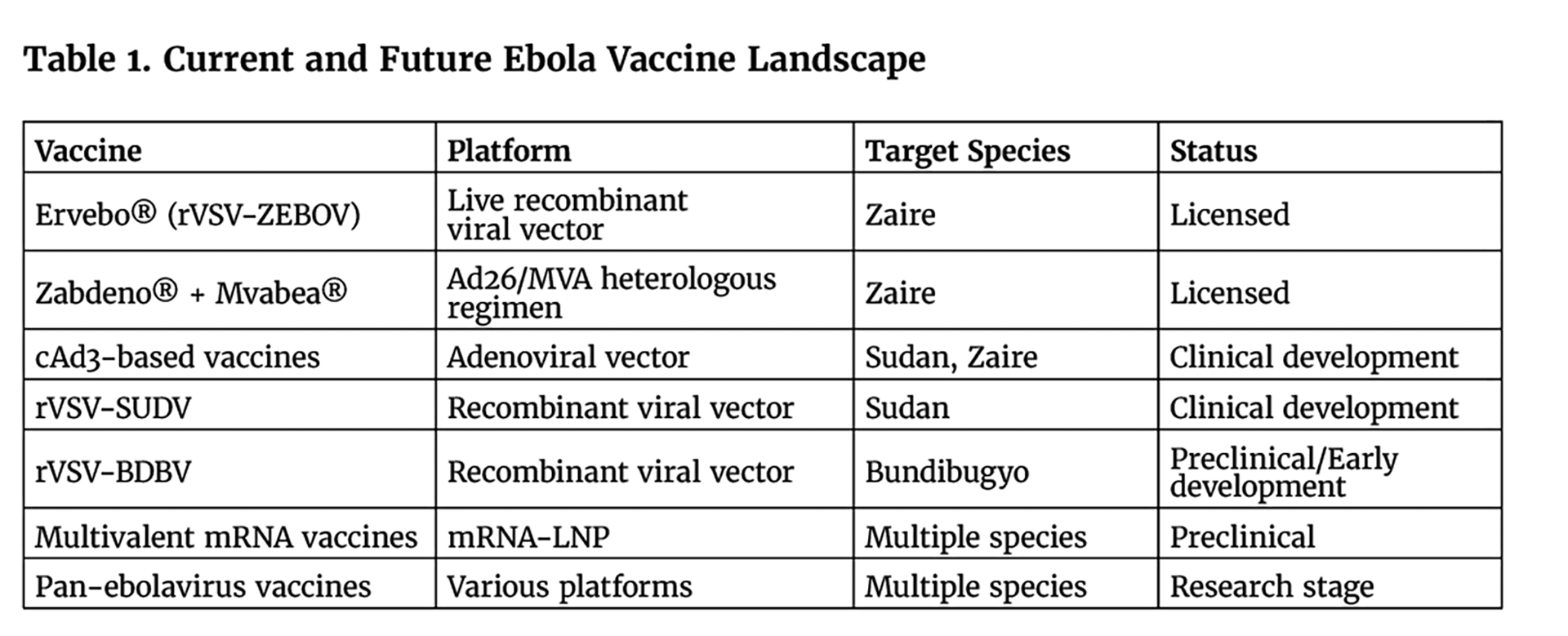
One of the greatest successes emerging from that crisis was the development of rVSV-ZEBOV (Ervebo®), a live recombinant vesicular stomatitis virus vaccine expressing the glycoprotein of Zaire ebolavirus. Clinical trials demonstrated remarkable efficacy, and ring-vaccination strategies contributed significantly to outbreak control in Guinea and later in the Democratic Republic of the Congo. In 2019, Ervebo® became the first licensed Ebola vaccine, representing a historic milestone in vaccinology. [4,5]
A second licensed strategy followed: the heterologous two-dose regimen consisting of Ad26.ZEBOV (Zabdeno®) and MVA-BN-Filo (Mvabea®). This platform provides durable immunity and is particularly useful for preventive vaccination in high-risk populations. Together, these vaccines transformed preparedness and response capabilities against Zaire Ebola virus disease. [6,7]
Yet the success of these vaccines also revealed an important limitation: they primarily target a single Ebola species.
The Challenge of Multiple Ebolaviruses
The genus Orthoebolavirus contains several species capable of causing human disease, including Zaire, Sudan, Bundibugyo, and Taï Forest ebolaviruses. Although these viruses share biological similarities, immune protection against one species does not necessarily confer adequate protection against another. [8]
The 2022 Sudan ebolavirus outbreak in Uganda highlighted this vulnerability. Despite the availability of highly effective vaccines against Zaire ebolavirus, no licensed vaccine existed for Sudan virus. Several candidate vaccines were rapidly evaluated, but the outbreak underscored the dangers of relying on species-specific vaccine approaches. [9]
The current Bundibugyo ebolavirus (BDBV) outbreak presents a similar challenge. Bundibugyo virus was first identified during an outbreak in Uganda in 2007 and remains relatively understudied compared with Zaire Ebola virus. Although existing vaccines may provide some degree of cross-reactive immunity, robust evidence supporting protection against BDBV is lacking. Consequently, public health authorities continue to rely heavily on traditional outbreak control measures, including surveillance, isolation, contact tracing, infection prevention, and community engagement. [10]
The Emerging Vaccine Pipeline
Recognizing these gaps, researchers have expanded efforts to develop vaccines targeting multiple ebolavirus species.
Several recombinant vesicular stomatitis virus (rVSV) candidates targeting Sudan and Bundibugyo viruses are currently under development. Similarly, adenovirus-vectored platforms are being evaluated for broader filovirus protection. Lessons learned from the rapid development of COVID-19 vaccines have accelerated regulatory pathways and strengthened international collaborations among governments, academic institutions, WHO, and vaccine manufacturers. The Coalition for Epidemic Preparedness Innovations (CEPI) will urgently accelerate development of three investigational vaccines targeting the BDBV that has caused a rapidly spreading epidemic in the Democratic Republic of the Congo (DRC) and neighboring Uganda. With no licensed vaccines available for BDBV and none in clinical development, CEPI’s action reflects the critical need to produce tools to help curtail the outbreak, complementing ongoing public health interventions by affected countries. CEPI will invest in a portfolio of candidates under development from longstanding partners with proven capabilities. These include candidates developed by IAVI; Moderna; and the University of Oxford, which will be manufactured at the Serum Institute of India (SII). As work on these candidates begins, CEPI will continue to evaluate additional promising candidates to strengthen the pipeline, including through an open Call for Proposals, and expects to announce additional partnerships shortly.
The current outbreak – declared a Public Health Emergency of International Concern (PHEIC) and a Public Health Emergency of Continental Security (PHECS) by the WHO and Africa CDC, respectively – has already caused more than 900 suspected cases and more than 220 suspected deaths, making it the third largest Filovirus outbreak in history. [11,12].
Perhaps the most exciting area of research is the pursuit of multivalent and pan-ebolavirus vaccines. These candidates aim to induce protective immunity against multiple Ebola species simultaneously. Structural biology and immunogen design are helping researchers identify conserved viral epitopes capable of generating broadly neutralizing immune responses. Although still largely in preclinical or early clinical development, these approaches may ultimately overcome the limitations of species-specific vaccines. [13]
The Promise of mRNA Technology
The success of mRNA vaccines during the COVID-19 pandemic has revolutionized vaccine development. The platform offers several advantages highly relevant to Ebola preparedness, including rapid design, scalable manufacturing, and flexibility for updating vaccine compositions in response to emerging threats. [14]
Multiple mRNA-based Ebola vaccine candidates are currently under evaluation. These vaccines can be designed to encode glycoproteins from multiple ebolavirus species, potentially creating multivalent formulations capable of protecting against Zaire, Sudan, Bundibugyo, and other filoviruses simultaneously. Early animal studies have demonstrated promising immunogenicity and protection, although clinical data remain limited. [15]
Beyond antigen design, mRNA technology may significantly shorten the time required to respond to emerging outbreaks. In future epidemics, candidate vaccines could potentially move from genetic sequencing to clinical evaluation within months rather than years, dramatically improving outbreak preparedness.
Beyond Vaccines: The Remaining Challenges
Despite impressive scientific progress, several challenges remain.
First, vaccine availability does not guarantee vaccine access. Outbreaks continue to occur primarily in regions with limited healthcare infrastructure, making rapid deployment difficult. Manufacturing capacity, cold-chain requirements, regulatory processes, and funding remain critical bottlenecks. [16]
Second, surveillance remains essential. Recent discoveries of Bombali ebolavirus and other novel filoviruses in bats demonstrate that our understanding of filovirus diversity remains incomplete. Emerging species could potentially evade existing vaccines and therapeutics. [17]
Third, the duration of protection and correlates of immunity remain incompletely understood. While current vaccines induce robust immune responses, the extent and duration of cross-species protection require further investigation. [18]
Fourth, public trust and community engagement remain indispensable. As demonstrated repeatedly during Ebola outbreaks, even the most effective vaccines cannot succeed without community acceptance and strong public health systems.
Finally, this outbreak—initially confined to the Mongbwalu health zone in Ituri Province, over the last two months, the outbreak has expanded to five provinces (Ituri, North Kivu, South Kivu, Haut-Uélé and Tshopo), now affecting 49 health zones. The outbreak is now the largest Ebola outbreak ever reported in the Democratic Republic of the Congo. As of 30 July 2026, a total of 3605 confirmed cases, including 1587 deaths, have been reported, corresponding to a crude case fatality ratio (CFR) of 44%. The continued increase in cases, expanding geographic spread, and persistently high mortality underscore the rapidly evolving nature of this public health emergency. —serves as a stark reminder of the persistent threat posed by emerging ebolaviruses. The public health risk is amplified by delayed diagnosis resulting from limited access to rapid, reliable point-of-care diagnostic tools, particularly in the resource-limited settings where Ebola outbreaks most commonly occur. Adding to these challenges, there is currently no licensed vaccine or approved virus-specific therapy for Bundibugyo ebolavirus (BDBV).
Beyond its immediate impact, the outbreak exposes critical vulnerabilities in regional and global epidemic preparedness, including gaps in surveillance systems, laboratory capacity, healthcare workforce readiness, community engagement, outbreak response logistics, and the availability of broad-spectrum medical countermeasures. Collectively, these shortcomings increase the likelihood of delayed outbreak detection, sustained transmission, cross-border spread, and substantial health, social, and economic consequences. The 2026 BDBV outbreak therefore underscores the urgent need to accelerate the development of next-generation, broadly protective Ebola vaccines and therapeutics, while simultaneously strengthening preparedness and response capacities at both national and international levels. [19-23].
Conclusions
The history of Ebola vaccine development represents one of the greatest achievements in modern vaccinology. Within a decade, the global scientific community transformed Ebola from a disease without preventive tools into one for which highly effective vaccines now exist. However, the 2026 Bundibugyo outbreak reminds us that success against a single ebolavirus species does not equate to preparedness against all ebolaviruses.
The next chapter of Ebola vaccination must focus on broadly protective, rapidly deployable, and globally accessible vaccines capable of protecting against multiple ebolavirus species. Advances in mRNA technology, multivalent vaccine design, and pan-ebolavirus immunogens offer unprecedented opportunities to achieve this goal.
Importantly, the 2026 outbreak also highlights a reality that cannot be ignored: infectious diseases do not respect borders. In an era of unprecedented global travel, trade, migration, urbanization, and environmental change, an outbreak that begins in a remote region can rapidly spread across countries and continents. Although Ebola has not yet caused a global pandemic on the scale of COVID-19, the repeated cross-border transmission events observed during recent outbreaks demonstrate that the risk is real and cannot be underestimated. The emergence of a more transmissible ebolavirus, or one capable of spreading silently for longer periods before detection, could have profound international consequences.
The ultimate objective is therefore no longer simply to respond to outbreaks—it is to prevent them before they begin. Achieving this goal will require sustained investment in surveillance, diagnostics, therapeutics, and next-generation vaccines, as well as stronger international collaboration to ensure that future Ebola outbreaks remain local public health emergencies rather than global crises.
References
- Feldmann H, Geisbert TW. Ebola haemorrhagic fever. Lancet. 2011 Mar 5;377(9768):849-62. doi: 10.1016/S0140-6736(10)60667-8.
- Jacob ST, Crozier I, Fischer WA 2nd, Hewlett A, Kraft CS, Vega MA, Soka MJ, Wahl V, Griffiths A, Bollinger L, Kuhn JH. Ebola virus disease. Nat Rev Dis Primers. 2020 Feb 20;6(1):13. doi: 10.1038/s41572-020-0147-3.
- WHO Ebola Response Team; Aylward B, Barboza P, Bawo L, Bertherat E, Bilivogui P, Blake I, Brennan R, Briand S, Chakauya JM, Chitala K, Conteh RM, Cori A, Croisier A, Dangou JM, Diallo B, Donnelly CA, Dye C, Eckmanns T, Ferguson NM, Formenty P, Fuhrer C, Fukuda K, Garske T, Gasasira A, Gbanyan S, Graaff P, Heleze E, Jambai A, Jombart T, Kasolo F, Kadiobo AM, Keita S, Kertesz D, Koné M, Lane C, Markoff J, Massaquoi M, Mills H, Mulba JM, Musa E, Myhre J, Nasidi A, Nilles E, Nouvellet P, Nshimirimana D, Nuttall I, Nyenswah T, Olu O, Pendergast S, Perea W, Polonsky J, Riley S, Ronveaux O, Sakoba K, Santhana Gopala Krishnan R, Senga M, Shuaib F, Van Kerkhove MD, Vaz R, Wijekoon Kannangarage N, Yoti Z. Ebola virus disease in West Africa–the first 9 months of the epidemic and forward projections. N Engl J Med. 2014 Oct 16;371(16):1481-95. doi: 10.1056/NEJMoa1411100.
- Henao-Restrepo AM, Camacho A, Longini IM, Watson CH, Edmunds WJ, Egger M, Carroll MW, Dean NE, Diatta I, Doumbia M, Draguez B, Duraffour S, Enwere G, Grais R, Gunther S, Gsell PS, Hossmann S, Watle SV, Kondé MK, Kéïta S, Kone S, Kuisma E, Levine MM, Mandal S, Mauget T, Norheim G, Riveros X, Soumah A, Trelle S, Vicari AS, Røttingen JA, Kieny MP. Efficacy and effectiveness of an rVSV-vectored vaccine in preventing Ebola virus disease: final results from the Guinea ring vaccination, open-label, cluster-randomised trial (Ebola Ça Suffit!). Lancet. 2017 Feb 4;389(10068):505-518. doi: 10.1016/S0140-6736(16)32621-6. Epub 2016 Dec 23. Erratum in: Lancet. 2017 Feb 4;389(10068):504. doi: 10.1016/S0140-6736(16)32633-2. Erratum in: Lancet. 2017 Feb 4;389(10068):504. doi: 10.1016/S0140-6736(17)30210-6.
- Regules JA, Beigel JH, Paolino KM, Voell J, Castellano AR, Hu Z, Muñoz P, Moon JE, Ruck RC, Bennett JW, Twomey PS, Gutiérrez RL, Remich SA, Hack HR, Wisniewski ML, Josleyn MD, Kwilas SA, Van Deusen N, Mbaya OT, Zhou Y, Stanley DA, Jing W, Smith KS, Shi M, Ledgerwood JE, Graham BS, Sullivan NJ, Jagodzinski LL, Peel SA, Alimonti JB, Hooper JW, Silvera PM, Martin BK, Monath TP, Ramsey WJ, Link CJ, Lane HC, Michael NL, Davey RT Jr, Thomas SJ; rVSV∆G-ZEBOV-GP Study Group. A Recombinant Vesicular Stomatitis Virus Ebola Vaccine. N Engl J Med. 2017 Jan 26;376(4):330-341. doi: 10.1056/NEJMoa1414216.
- Pollard AJ, Launay O, Lelievre JD, Lacabaratz C, Grande S, Goldstein N, Robinson C, Gaddah A, Bockstal V, Wiedemann A, Leyssen M, Luhn K, Richert L, Bétard C, Gibani MM, Clutterbuck EA, Snape MD, Levy Y, Douoguih M, Thiebaut R; EBOVAC2 EBL2001 study group. Safety and immunogenicity of a two-dose heterologous Ad26.ZEBOV and MVA-BN-Filo Ebola vaccine regimen in adults in Europe (EBOVAC2): a randomised, observer-blind, participant-blind, placebo-controlled, phase 2 trial. Lancet Infect Dis. 2021 Apr;21(4):493-506. doi: 10.1016/S1473-3099(20)30476-X.
- Anywaine Z, Whitworth H, Kaleebu P, Praygod G, Shukarev G, Manno D, Kapiga S, Grosskurth H, Kalluvya S, Bockstal V, Anumendem D, Luhn K, Robinson C, Douoguih M, Watson-Jones D. Safety and Immunogenicity of a 2-Dose Heterologous Vaccination Regimen With Ad26.ZEBOV and MVA-BN-Filo Ebola Vaccines: 12-Month Data From a Phase 1 Randomized Clinical Trial in Uganda and Tanzania. J Infect Dis. 2019 Jun 5;220(1):46-56. doi: 10.1093/infdis/jiz070.
- Walker PJ, Siddell SG, Lefkowitz EJ, Mushegian AR, Dempsey DM, Dutilh BE, Harrach B, Harrison RL, Hendrickson RC, Junglen S, Knowles NJ, Kropinski AM, Krupovic M, Kuhn JH, Nibert M, Rubino L, Sabanadzovic S, Simmonds P, Varsani A, Zerbini FM, Davison AJ. Changes to virus taxonomy and the International Code of Virus Classification and Nomenclature ratified by the International Committee on Taxonomy of Viruses (2019). Arch Virol. 2019 Sep;164(9):2417-2429. doi: 10.1007/s00705-019-04306-w.
- Kabami Z, Ario AR, Harris JR, Ninsiima M, Ahirirwe SR, Ocero JRA, Atwine D, Mwebesa HG, Kyabayinze DJ, Muruta AN, Kagirita A, Tegegn Y, Nanyunja M, Kizito SN, Kadobera D, Kwesiga B, Gidudu S, Migisha R, Makumbi I, Eurien D, Elyanu PJ, Ndyabakira A, Naiga HN, Zalwango JF, Agaba B, Kawungezi PC, Zalwango MG, King P, Simbwa BN, Akunzirwe R, Wanyana MW, Zavuga R, Kiggundu T; Uganda Ebola Response Team. Ebola disease outbreak caused by the Sudan virus in Uganda, 2022: a descriptive epidemiological study. Lancet Glob Health. 2024 Oct;12(10):e1684-e1692. doi: 10.1016/S2214-109X(24)00260-2.
- Towner JS, Sealy TK, Khristova ML, Albariño CG, Conlan S, Reeder SA, Quan PL, Lipkin WI, Downing R, Tappero JW, Okware S, Lutwama J, Bakamutumaho B, Kayiwa J, Comer JA, Rollin PE, Ksiazek TG, Nichol ST. Newly discovered ebola virus associated with hemorrhagic fever outbreak in Uganda. PLoS Pathog. 2008 Nov;4(11):e1000212. doi: 10.1371/journal.ppat.1000212.
- CEPI fast-tracks three Bundibugyo ebolavirus vaccine candidates. https://cepi.net/cepi-fast-tracks-three-bundibugyo-ebolavirus-vaccine-candidates.
- Ebola disease caused by Bundibugyo virus, Democratic Republic of the Congo & Uganda. https://www.who.int/emergencies/disease-outbreak-news/item/2026-DON605.
- Xu D, Powell AE, Utz A, Sanyal M, Do J, Patten JJ, Moliva JI, Sullivan NJ, Davey RA, Kim PS. Design of universal Ebola virus vaccine candidates via immunofocusing. Proc Natl Acad Sci U S A. 2024 Feb 13;121(7):e2316960121. doi: 10.1073/pnas.2316960121.
- Pardi N, Hogan MJ, Porter FW, Weissman D. mRNA vaccines – a new era in vaccinology. Nat Rev Drug Discov. 2018 Apr;17(4):261-279. doi: 10.1038/nrd.2017.243.
- Schäfer A, Marzi A, Furuyama W, Catanzaro NJ, Nguyen C, Haddock E, Feldmann F, Meade-White K, Thomas T, Hubbard ML, Gully KL, Leist SR, Hock P, Bell TA, De la Cruz GE, Midkiff BR, Martinez DR, Shaw GD, Miller DR, Vernon MJ, Graham RL, Cowley DO, Montgomery SA, Schughart K, de Villena FPM, Wilkerson GK, Ferris MT, Feldmann H, Baric RS. Mapping of susceptibility loci for Ebola virus pathogenesis in mice. Cell Rep. 2024 May 28;43(5):114127. doi: 10.1016/j.celrep.2024.114127.
- Frieden TR, Damon I, Bell BP, Kenyon T, Nichol S. Ebola 2014–new challenges, new global response and responsibility. N Engl J Med. 2014 Sep 25;371(13):1177-80. doi: 10.1056/NEJMp1409903.
- Goldstein T, Anthony SJ, Gbakima A, Bird BH, Bangura J, Tremeau-Bravard A, Belaganahalli MN, Wells HL, Dhanota JK, Liang E, Grodus M, Jangra RK, DeJesus VA, Lasso G, Smith BR, Jambai A, Kamara BO, Kamara S, Bangura W, Monagin C, Shapira S, Johnson CK, Saylors K, Rubin EM, Chandran K, Lipkin WI, Mazet JAK. The discovery of Bombali virus adds further support for bats as hosts of ebolaviruses. Nat Microbiol. 2018 Oct;3(10):1084-1089. doi: 10.1038/s41564-018-0227-2. Epub 2018 Aug 27. Erratum in: Nat Microbiol. 2018 Dec;3(12):1486. doi: 10.1038/s41564-018-0315-3.
- Kahusu CM, Peckeu-Abboud L, Goovaerts O, Matungulu É, Heyndrickx L, Ariën KK, Oostvogels S, Mubiala A, Milua S, Mbilizi IM, Shamamba S, Bayoka N, Ishara-Nshombo E, Tshimanga C, Nkuba A, Peeters M, Bazola B, Sabue J, Ngimba M, Mukanya N, Tshita P, Kinzungu C, Kasumba DM, Tshiani O, Mbala-Kingebeni P, Liesenborghs L, Mukadi-Bamuleka D, Mulangu S, Kavunga-Membo H, Adriaensen W. Long-term antibody responses to the Ebola virus and the vaccine vector after rVSV-ZEBOV vaccination in DRC. Vaccine. 2025 Aug 30;62:127537. doi: 10.1016/j.vaccine.2025.127537. Epub 2025 Jul 23. Erratum in: Vaccine. 2025 Oct 3;64:127719. doi: 10.1016/j.vaccine.2025.127719.
- Nachega JB, Mbala-Kingebeni P, Mulangu S, Ndembi N, Preiser W, Skinner D, Sam-Agudu NA, Ntoumi F, Tegally H, Baxter C, Oliveira T, Bosa HK, Kaleebu P, Kallay O, Uthman OA, Mills EJ, Rosenthal PJ, Zumla A, Muyembe-Tamfum JJ. Ebola outbreak caused by Bundibugyo virus: challenges and priorities for epidemic preparedness and response. Lancet. 2026 Jun 9:S0140-6736(26)01141-4. doi: 10.1016/S0140-6736(26)01141-4.
- Bosa HK, Wayengera M, Kagirita A, Lubwama B, Muruta A, Nabadda S, Nsawotebba A, Olaro C, Atwine D, Aceng JR. Cross-border transmission of Ebola virus disease caused by Bundibugyo virus into Uganda, 2026. Lancet Infect Dis. 2026 Jun 1:S1473-3099(26)00288-4. doi: 10.1016/S1473-3099(26)00288-4.
- Belizaire MR, Chamla D, Janabi M. Bundibugyo virus disease outbreak in DR Congo: current trajectory and potential risk for a Pandemic Emergency. Lancet Infect Dis. 2026 Jun 5:S1473-3099(26)00298-7. doi: 10.1016/S1473-3099(26)00298-7.
- WHO: Ebola disease caused by Bundibugyo virus – Democratic Republic of the Congo. https://www.who.int/emergencies/disease-outbreak-news/item/2026-DON614.
- WHO calls for Phase III Ervebo vaccine trial amid Bundibugyo Ebola outbreak. https://www.clinicaltrialsarena.com/news/who-calls-for-phase-iii-ervebo-vaccine-trial-amid-bundibugyo-ebola-outbreak/.