
Introduction:
Aluminum is a ubiquitous element in the environment and a common component of the human diet, with regular exposure occurring through multiple food sources. Although aluminum salts are used as adjuvants in certain vaccines to enhance immune responses, the quantity per dose is low and carefully regulated. In contrast, daily dietary intake generally results in higher cumulative exposure. The following examples provide context by highlighting foods that may contain greater amounts of aluminum than a single vaccine dose. Importantly, extensive epidemiological and pharmacovigilance data have consistently shown no credible evidence linking aluminum exposure from vaccines to autism.
Aluminum Exposure: Vaccines and Common Dietary Sources
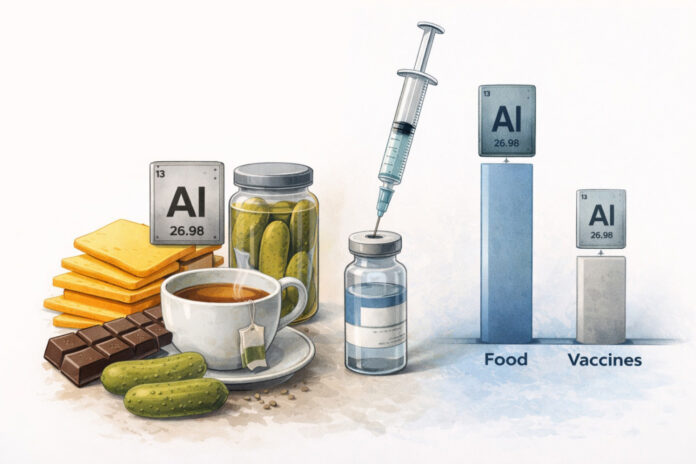
Aluminum is a ubiquitous element present in the environment, food, and medical products. While aluminum salts are used as adjuvants in certain vaccines to enhance immune responses, the amount per dose is small and tightly regulated. In contrast, routine dietary intake frequently results in higher cumulative exposure. The following comparison provides context:
1. Vaccines (Reference Benchmark)
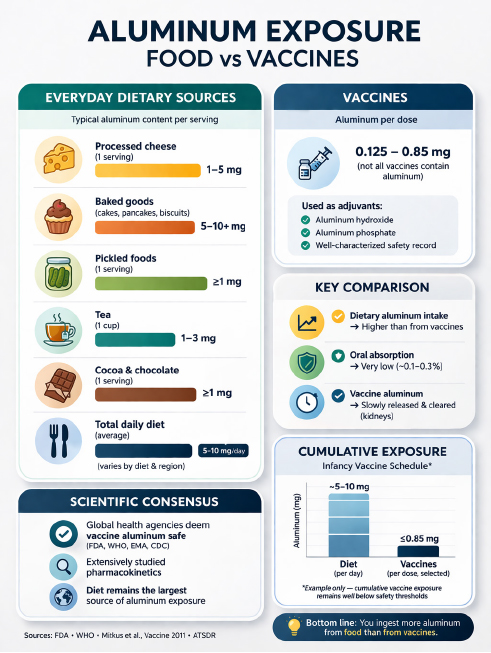
Aluminum salts (e.g., aluminum hydroxide, aluminum phosphate) are used as adjuvants to improve immunogenicity. The amount of aluminum per vaccine dose is ≤0.85 mg, depending on the formulation. This serves as a reference point when comparing exposure from other sources.
2. Processed Cheese and Cheese Spreads
Processed cheeses may contain aluminum-based additives such as sodium aluminum phosphate, used as emulsifiers to improve texture and stability. A single serving can contain approximately 1–5 mg of aluminum, often exceeding the amount in a vaccine dose.
3. Baked Goods (Cakes, Pancakes, Biscuits)
Aluminum-containing baking powders (e.g., sodium aluminum sulfate) are commonly used in commercial baking. These products may contain ~5–10 mg or more per serving, representing one of the highest dietary sources.
4. Pickled Foods
Aluminum salts may be used during processing to maintain firmness and crispness. Although levels vary, these foods can contain >1 mg per serving.
5. Tea (Especially Black Tea)
Tea plants naturally accumulate aluminum from soil. Brewed tea may contain ~1–3 mg per cup, depending on preparation and origin.
6. Cocoa and Chocolate
Cocoa products also contribute to aluminum intake due to natural accumulation in plants, with ≥1 mg per serving in some cases.
Key Comparison
- Average daily dietary aluminum intake: ~5–10 mg/day (and potentially higher depending on diet)
- Aluminum per vaccine dose: ≤0.85 mg
Interpretation: Dietary exposure to aluminum typically exceeds vaccine-derived exposure.
Pharmacokinetic Considerations
- Oral absorption: Very low (~0.1–0.3%), with most ingested aluminum excreted
- Injected aluminum (vaccines): Slowly released from the injection site and eliminated primarily via the kidneys
- Safety framework: Agencies such as the Food and Drug Administration and the World Health Organization evaluate aluminum exposure based on total body burden and clearance, ensuring established safety margins
Importantly, extensive epidemiological and clinical research—including large population-based studies—has consistently demonstrated that neither aluminum exposure nor vaccines are associated with autism.
Conclusions
- Aluminum exposure is common and unavoidable in everyday life
- The quantity of aluminum in vaccines is low, controlled, and extensively studied
- Dietary sources contribute substantially more aluminum than vaccines
- Robust scientific evidence shows that neither aluminum nor vaccines are linked to autism.
Bibliography:
- Mitkus RJ, King DB, Hess MA, Forshee RA, Walderhaug MO. Updated aluminum pharmacokinetics following infant exposures through diet and vaccination. Vaccine. 2011 Nov 28;29(51):9538-43. doi: 10.1016/j.vaccine.2011.09.124.
- Statement of the WHO Global Advisory Committee on Vaccine Safety (GACVS) on vaccines and autism. https://www.who.int/news/item/11-12-2025-statement-gacvs-vaccines-autism#:~:text=GACVS%20also%20reviewed%20a%20recent,both%2C%20do%20not%20cause%20autism.&text=%5B5%5D%20Andersson%20NW%2C%20Bech,/ANNALS%2D25%2D00997.
- WHO: Aluminum Adjuvants. Extract from report of GACVS meeting of 6-7 June 2012, published in the WHO Weekly Epidemiological Record on 27 July 2012. https://www.who.int/groups/global-advisory-committee-on-vaccine-safety/topics/adjuvants
- FDA: Common Ingredients in FDA-Approved Vaccines. Content current as of:03/02/2026. https://www.atsdr.cdc.gov/toxprofiles/tp22-c1-b.pdf
- Saiyed SM, Yokel RA. Aluminium content of some foods and food products in the USA, with aluminium food additives. Food Addit Contam. 2005 Mar;22(3):234-44. doi: 10.1080/02652030500073584.
- Yokel RA. Aluminum in beverages and foods: A comprehensive compilation of regulations; concentrations in raw, prepared, and stored beverages and foods; and intake. Compr Rev Food Sci Food Saf. 2025 May;24(3):e70175. doi: 10.1111/1541-4337.70175.
- Moser CA, Offit PA. Aluminum Exposure From Vaccines and Diet. JAMA. 2026 Mar 17;335(11):939-942. doi: 10.1001/jama.2026.0056.
- Nirenberg E, Maldonado YA, Hoffman SA. The Role and Safety of Aluminum Adjuvants in Childhood Vaccines. Pediatrics. 2026 Mar 1;157(3):e2025074874. doi: 10.1542/peds.2025-074874.
- Andersson NW, Bech Svalgaard I, Hoffmann SS, Hviid A. Aluminum-Adsorbed Vaccines and Chronic Diseases in Childhood : A Nationwide Cohort Study. Ann Intern Med. 2025 Oct;178(10):1369-1377. doi: 10.7326/ANNALS-25-00997. Epub 2025 Jul 15. Erratum in: Ann Intern Med. 2025 Oct;178(10):1527. doi: 10.7326/ANNALS-25-03233.
- Conklin L, Hviid A, Orenstein WA, Pollard AJ, Wharton M, Zuber P. Vaccine safety issues at the turn of the 21st century. BMJ Glob Health. 2021 May;6(Suppl 2):e004898. doi: 10.1136/bmjgh-2020-004898.
- Löffler P. Review: Vaccine Myth-Buster – Cleaning Up With Prejudices and Dangerous Misinformation. Front Immunol. 2021 Jun 10;12:663280. doi: 10.3389/fimmu.2021.663280.
- Geoghegan S, O’Callaghan KP, Offit PA. Vaccine Safety: Myths and Misinformation. Front Microbiol. 2020 Mar 17;11:372. doi: 10.3389/fmicb.2020.00372.